
Aluminium Alloy vs 304 Stainless Steel Hinge Shower Doors: KL-AS5507310 vs KL-AS5577310
Short answer first. Hinge shower door KL-AS5507310 runs on aluminium alloy hardware and fits lighter residential and commercial hospitality bathrooms where ventilation works and hardware weight matters. Hinge shower door KL-AS5577310 runs on 304 stainless steel hardware in a frameless build and fits environments that ask for higher corrosion resistance: coastal sites, high-occupancy hotels, spa bathrooms and rooms where the door stays wet for long stretches. Both are hinge (hinged) shower doors supplied by Foshan SHKL Sanitary Ware Co., Ltd, and both accept the same glass craftsmanship options: clear glass, tinted glass, laminated glass, flute glass, chemically frosted glass, easy-clean and film-coated.
This comparison keeps the scope narrow on purpose: two hinge builds, one material question, and a three-point checklist at the end. It covers what the hardware material change actually affects, what each build is specified for, and how global buyers normally close this decision during research and evaluation.
Why the hardware material is a project decision, not a spec detail
A hinge shower door is one large glass panel carried by a small number of metal parts: hinge blocks, handle, wall fittings and seals. The glass is the part that regulation governs. The hardware is the part that determines how the door behaves in daily use. When buyers compare aluminium alloy with 304 stainless steel, they are usually deciding three things at the same time:
- Corrosion exposure. Hinges and fittings sit inside the splash zone of the wettest room in a building, so the material choice is an environmental decision before it is a cosmetic one.
- Weight and swing feel. Hardware material affects how the panel feels each time it opens, and how the load is distributed across an unsupported glass panel.
- Specification risk. A material mismatch on a coastal or high-occupancy site is typically discovered after handover, not during ordering.
That is why the question "do I need 304 stainless steel?" has no single answer. It depends on the bathroom's humidity, how many times the door opens each day, and what the design language of the room requires.
Market and standards context for hinge shower doors
Scale is a useful starting point. The global shower doors market was valued at USD 13.5 billion in 2023 according to Cognitive Market Research (Global Shower Doors Market Report, 2024 edition). Within North America, frameless shower glass doors held a 75% share of the frameless category as of 2025, per the same source. Frameless is therefore not a niche premium format in that market, and hardware that supports an all-glass appearance carries real commercial weight.
Three technical references come up repeatedly in buyer conversations:
- EN 14428:2015+A1:2018 (European Committee for Standardization) sets functional requirements and test methods for shower enclosures, and is the reference used for European domestic enclosures.
- ASTM C1048-18 (ASTM International) is the standard specification for heat-strengthened and fully tempered flat glass used in architectural applications.
- National Glass Association, Frameless Shower Enclosures Design Guide states that shower-enclosure glass should be safety glazing meeting the federal impact requirement of CPSC 16 CFR 1201, and that the frameless category typically uses monolithic tempered glass of at least 3/8 inch (10 mm) or thicker.
Two caveats matter. First, the National Glass Association figure describes a category, not a universal minimum for every door configuration. Second, all three references address glass. The choice between aluminium alloy and 304 stainless steel hardware remains a project-environment and appearance decision, which is exactly why it deserves its own selection logic rather than a line in a certificate folder.
The two hinge builds, described
KL-AS5507310: hinge shower door with aluminium alloy hardware
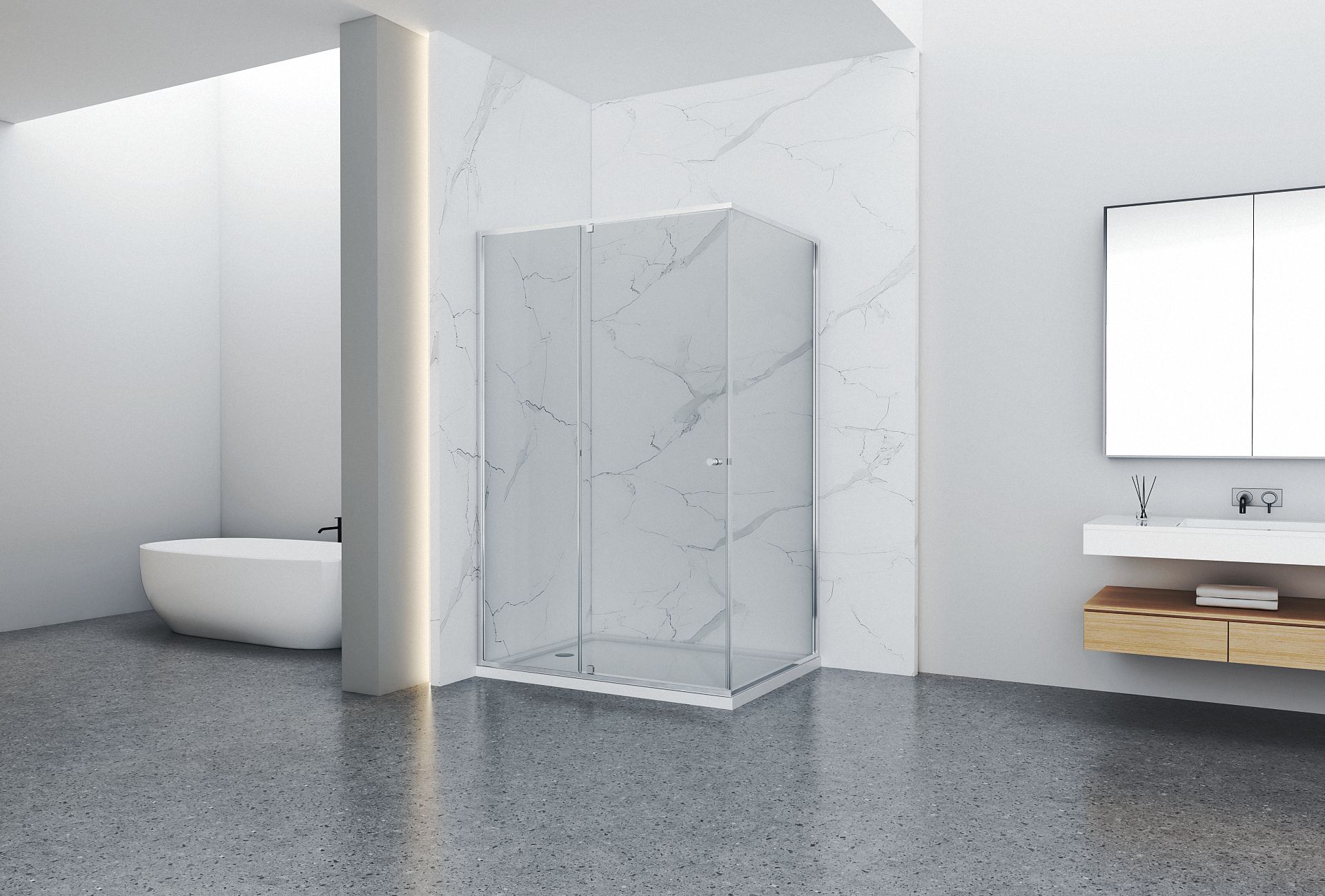
Hinge shower door KL-AS5507310, built on aluminium alloy hardware.
KL-AS5507310 is a hinge shower door with aluminium alloy hardware, listed by the manufacturer for residential construction and commercial hospitality. Its glass craftsmanship options are clear glass, tinted glass, laminated glass, flute glass, chemically frosted glass, easy-clean and film-coated.
In project terms this is the build for bathrooms where the enclosure is used in short, well-ventilated cycles: family bathrooms, guest bathrooms, apartment units and mid-range hotel rooms. Aluminium alloy keeps the hardware lighter, which suits doors opened and closed a limited number of times per day, and specifications where the metal is expected to perform reliably without becoming the visual focus of the room.
KL-AS5577310: hinge shower door with 304 stainless steel hardware
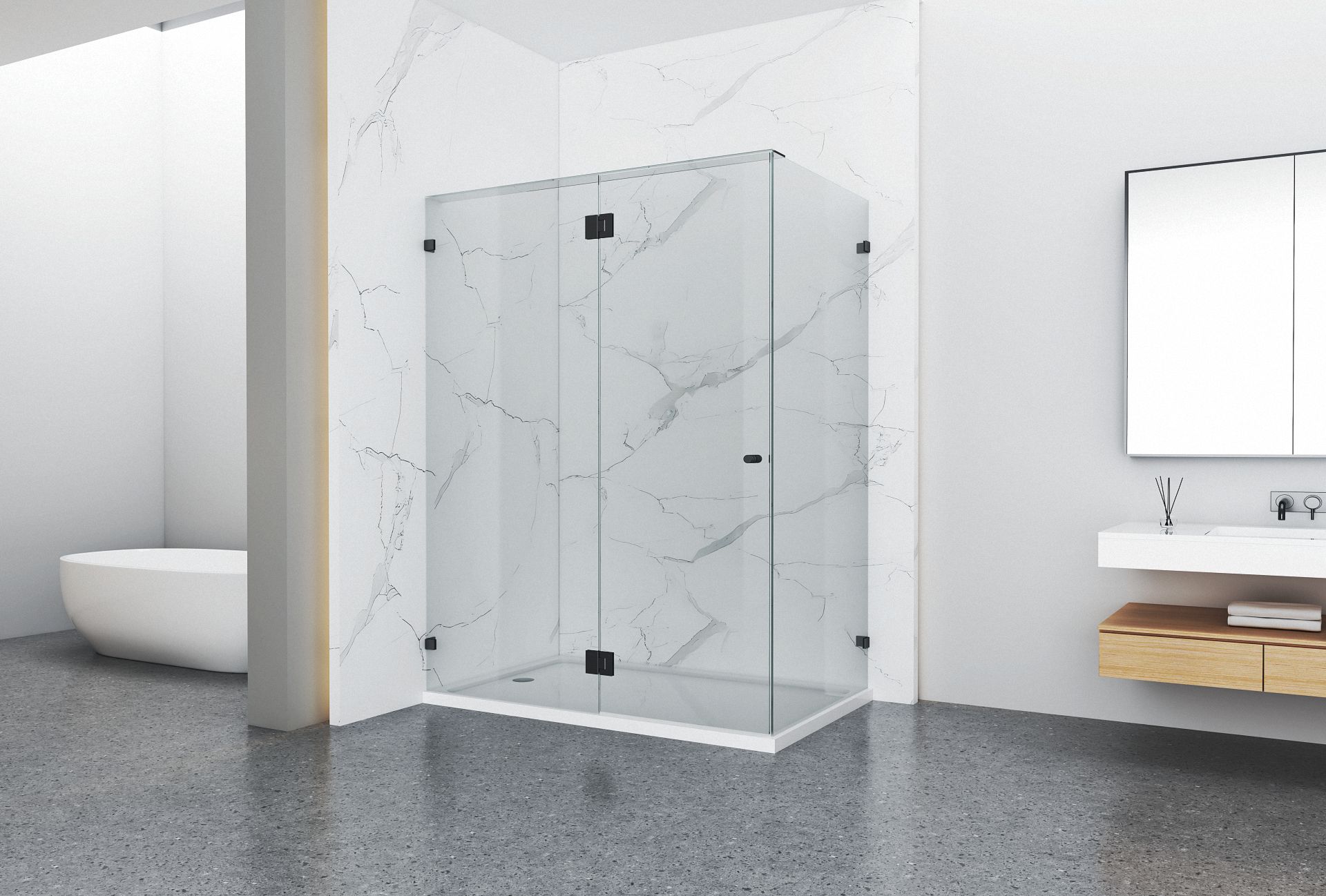
Hinge shower door KL-AS5577310, built on 304 stainless steel hardware.
KL-AS5577310 is a hinge shower door built on 304 stainless steel hardware and offered in a frameless configuration. It carries the same applicable-industry scope as its aluminium counterpart, residential construction and commercial hospitality, and the same glass craftsmanship list: clear glass, tinted glass, laminated glass, flute glass, chemically frosted glass, easy-clean and film-coated.
Where this build earns its place is environmental durability. 304 stainless steel is specified where the hardware lives in persistent moisture: coastal regions with salt-laden air, hotels running near full occupancy with minimal drying time between uses, spa and wellness bathrooms, and projects that expect fittings to remain visually unchanged long after handover.
What both builds share
The glass menu is identical on both models, which is what keeps this a genuine either-or decision rather than a two-tier compromise:
- Clear glass
- Tinted glass
- Laminated glass
- Flute glass
- Chemically frosted glass
- Easy-clean
- Film-coated
SHKL's glass shower door range also lists 6 mm, 8 mm, 10 mm and 12 mm tempered glass options. Because the glass specification is common to both builds, the hardware decision never forces a compromise on the glass side: laminated glass for anti-shatter behaviour, or easy-clean and film-coated surfaces for simpler maintenance, can be specified on either model.
Step-by-step: how to choose between aluminium alloy and 304 stainless steel
Step 1: Score the bathroom's humidity and daily duty
Sort the project bathroom into one of three bands. Low humidity: guest bathroom or second bathroom with mechanical extraction and air movement through the day. Medium humidity: a family bathroom used several times daily with normal ventilation. High humidity: coastal buildings, windowless interior bathrooms, spa and wellness areas, and hotel rooms where the next guest checks in before the room fully dries. Aluminium alloy hardware is proportionate in the first band, either build works in the second, and 304 stainless steel hardware is the lower-risk specification in the third.
Step 2: Decide framed or frameless before you decide the material
The framed-versus-frameless choice changes how much metal is visible in the room, and therefore how much the hardware material shows. If the design brief calls for an unbroken all-glass look, KL-AS5577310's 304 stainless steel hardware and frameless build fit that language directly. If the project runs standard residential or framed specifications, aluminium alloy keeps hardware weight and fitting complexity down. SHKL also lists a separate frameless shower door model, KL-AS5104310, for buyers who want a frameless format in another configuration.
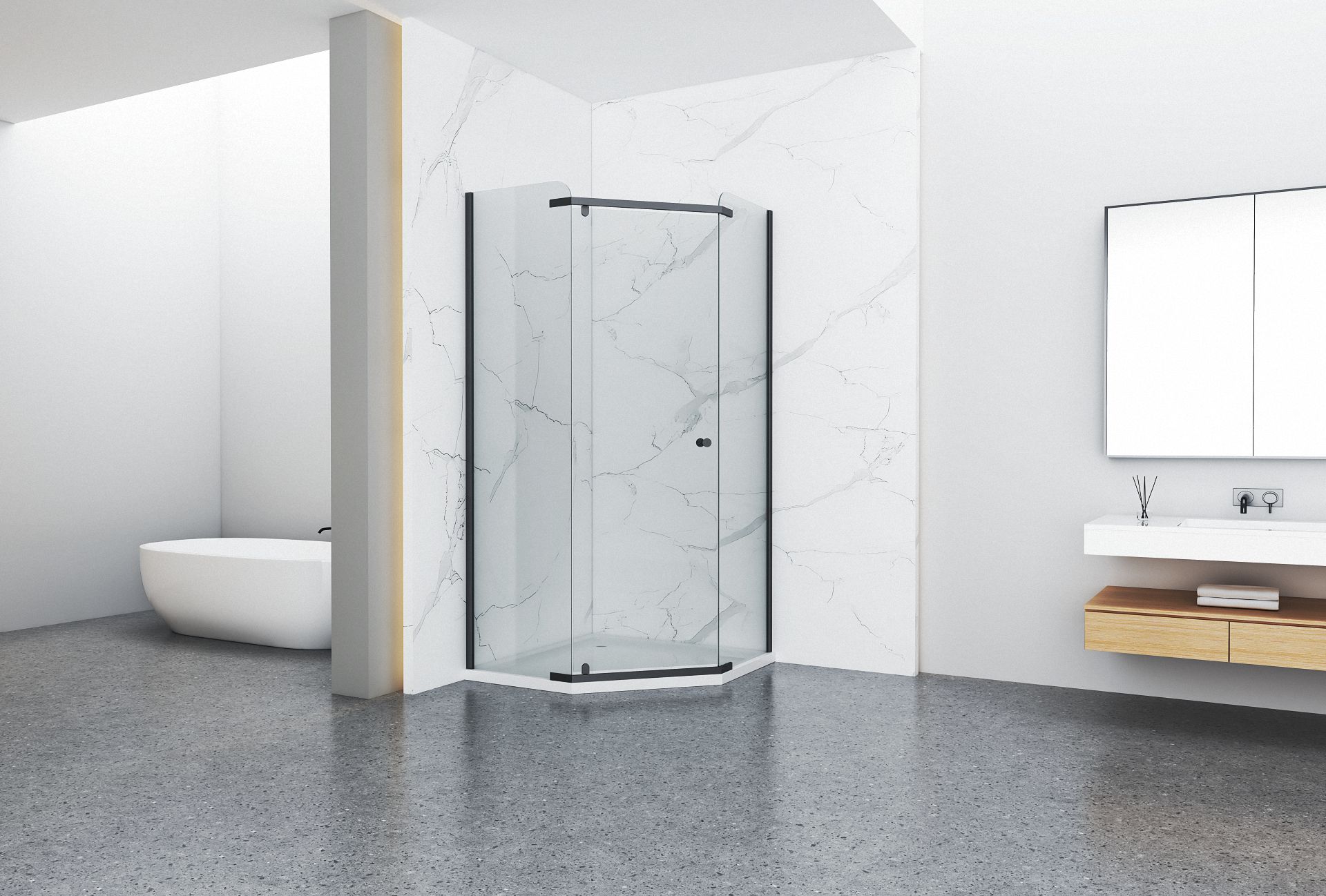
Frameless shower door configuration, shown here as a design reference for the framed-versus-frameless decision.
Step 3: Match the build to the project type
A villa or custom home usually needs one specification, judged on how the owner will live with it. A hotel or multi-unit residential programme needs one specification repeated across dozens or hundreds of rooms, judged on how the operator will maintain it. Volume, replacement logistics and turnover cycles all push the same direction: the more permanent the moisture exposure and the heavier the usage, the stronger the case for 304 stainless steel hardware.
Step 4: Lock glass thickness and craftsmanship
Both builds draw on the same tempered glass thickness options of 6 mm, 8 mm, 10 mm and 12 mm, and the same craftsmanship list. For frameless applications, the National Glass Association design guide describes monolithic tempered glass of at least 3/8 inch (10 mm) or thicker for the frameless category in its United States context, so a 10 mm or 12 mm glass specification is the natural pairing with a frameless hinge build. Where safety retention is a priority, laminated glass is available on either model.
Step 5: Verify documents and validate a sample
Ask for the glass test documentation and the supplier's management-system certificates, confirm the scope and covered sites, and request a physical sample of the exact build under evaluation before committing to a production order. Hardware material, glass thickness and glass craftsmanship are all visible in a sample in a way that a specification sheet alone cannot convey.
Project scenarios where each build fits
Residential villas and custom homes
In villa and custom-home projects the shower enclosure is one element of a wider wet-dry separation layout, typically paired with a ceramic basin, an LED mirror and a faucet on the vanity side. Special requirements in these bathrooms commonly include moisture-proof, mildew-resistant and scratch-resistant surfaces. Where the bathroom is well ventilated and used by a household, aluminium alloy hinge hardware is normally the proportionate choice; where the villa sits on a coastline, the same layout justifies the 304 stainless steel build.
Hotels, resorts and commercial hospitality
Hospitality is the environment where the two builds separate most clearly, because occupancy controls how often the door runs wet. SHKL has delivered a customised 190-unit shower door programme for a project in Australia, described as meeting Australian safety standards with smooth installation and a good outcome on sizing and function. In programmes of that shape, where every room is inspected to the same standard and hardware consistency matters across floors, 304 stainless steel hardware is the specification that protects the operator's maintenance budget.
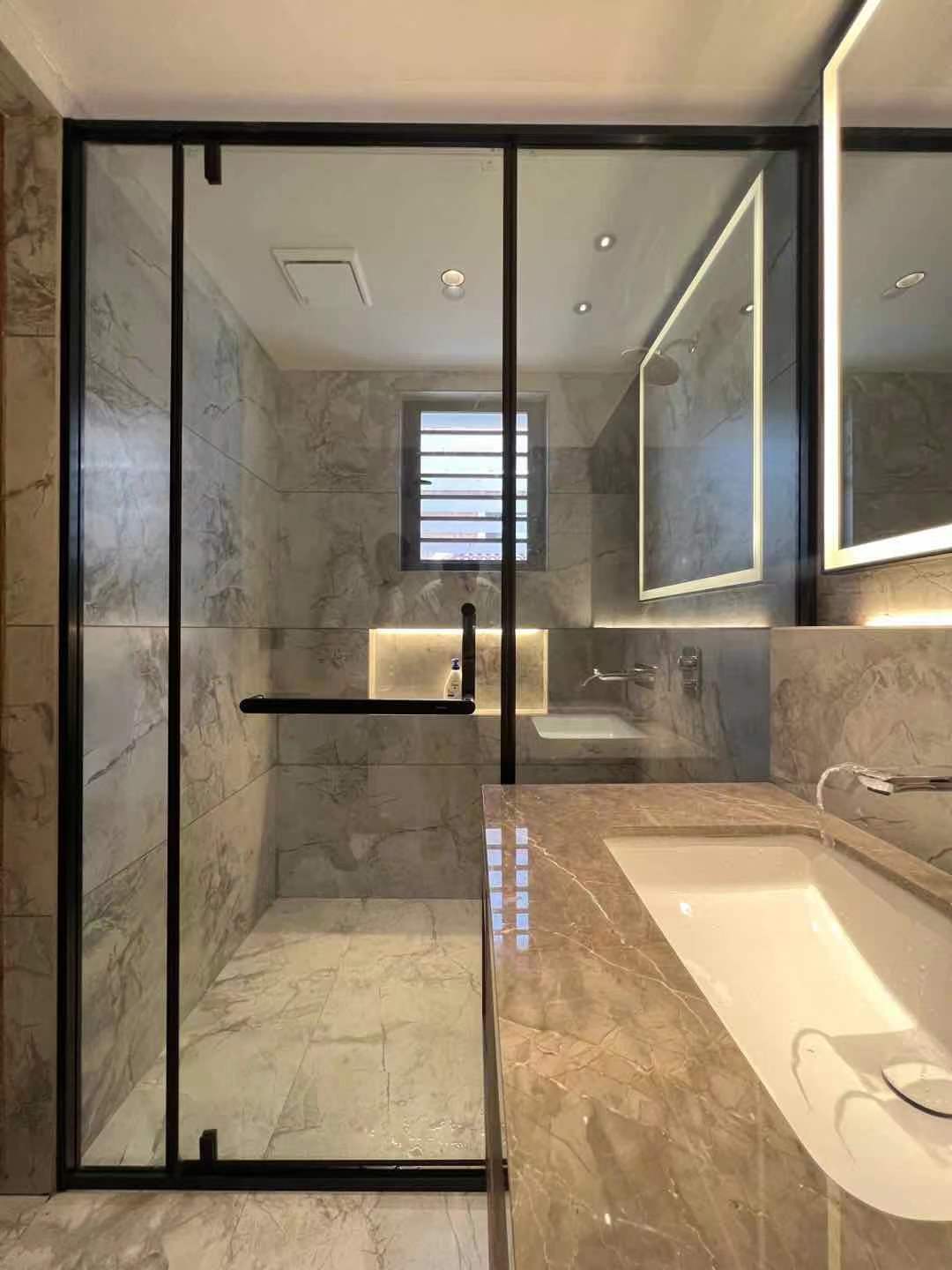
Shower door project case: a 190-unit customised shower door programme for a bathroom installation in Australia.
Coastal, spa and high-humidity bathrooms
These are the bathrooms where the hardware material is decided by the environment rather than by budget. Salt-laden air, continuous steam and repeated wet-dry cycling all push the specification toward 304 stainless steel. A separate 110-unit customised shower door programme in Thailand used laminated safety glass with an anti-shatter design to raise user safety, which illustrates how hardware and glass decisions are usually solved together in humid markets.
Fit-outs where the shower door sits beside bathroom furniture
In many hotel projects the shower enclosure is specified alongside bathroom furniture in the same wet zone, sharing the same humidity load and the same matched equipment list: ceramic basin, LED mirror, shower enclosure and faucet. A 250-unit customised hotel bathroom furniture project in the United States, delivered on time and described as meeting United States market standards, is a typical example of that combined approach. When the enclosure and the vanity wall face the same conditions, matching hardware material to the bathroom environment rather than to a single line item is the more durable decision.
Head-to-head comparison table
| Dimension | KL-AS5507310 | KL-AS5577310 |
|---|---|---|
| Door type | Hinge shower door | Hinge shower door |
| Hardware material | Aluminium alloy | 304 stainless steel |
| Configuration in this comparison | Hinge build as listed | Hinge build, frameless |
| Glass craftsmanship options | Clear, tinted, laminated, flute, chemically frosted, easy-clean, film-coated | Clear, tinted, laminated, flute, chemically frosted, easy-clean, film-coated |
| Typical project fit | Lighter residential and commercial hospitality specifications with managed humidity | Higher-corrosion-resistance environments: coastal, high-occupancy hospitality, spa bathrooms |
| Applicable industry | Residential construction, commercial hospitality | Residential construction, commercial hospitality |
| Customisation scope (SHKL OEM) | Size, colour, material, finish, hardware, logo, design style | Size, colour, material, finish, hardware, logo, design style |
Tempered glass thickness options of 6 mm, 8 mm, 10 mm and 12 mm are listed for SHKL's glass shower door range; confirm the exact thickness for the selected model on the quotation.
FAQ
What standards apply to hinge shower doors, and how should a buyer check them?
Three references cover the glass side. EN 14428:2015+A1:2018 sets functional requirements and test methods for shower enclosures and is the reference used for European domestic enclosures. ASTM C1048-18 is the standard specification for heat-strengthened and fully tempered flat glass. The National Glass Association's frameless enclosures design guide states that shower-enclosure glass should be safety glazing meeting the impact requirement of CPSC 16 CFR 1201, and describes monolithic tempered glass of at least 3/8 inch (10 mm) for the frameless category in its United States context. On the supplier side, SHKL reports ISO 9001 (certificate 04924Q00629R0M), ISO 14001 (04924E00351R0M) and ISO 45001 (04924S00316R0M), issued on 11 May 2024 and reported valid until 10 May 2027. Buyers should request certificate copies, confirm the scope and covered production sites, and treat management-system certificates as separate from product conformity test reports for a specific hinge shower door model.
Can both hinge models be customised to project sizes and finishes?
Yes. SHKL operates an OEM model with customisation across size, colour, material, finish, hardware, logo and design style, a minimum order quantity of 50 units and 100% inspection. Manufacturing runs across a production base of 100,000 m² in China and a 40,000 m² factory in Ho Chi Minh City, Vietnam, with a 600-person workforce and a 20-person R&D team. Products are distributed across more than 50 countries and regions, with an export ratio of 70%. Because KL-AS5507310 and KL-AS5577310 share the same glass craftsmanship list, the customisation path does not depend on which hardware material you select.
Which build costs more, and how is pricing structured?
SHKL does not publish list prices for these hinge models, so quotations are configuration-based rather than catalogue-based. A quotation is built from the hardware material selected, glass thickness from the 6 mm, 8 mm, 10 mm and 12 mm tempered options, the glass craftsmanship choice from clear, tinted, laminated, flute, chemically frosted, easy-clean or film-coated, the door size and configuration, and the order volume measured against a minimum order quantity of 50 units. When comparing suppliers on this pair of builds, quoting both models on the same configuration basis is the only way to read the price difference correctly.
Can I validate a sample before placing a production order?
Sample validation is the normal route for both hinge builds. Because the hardware material, glass thickness and glass craftsmanship are all physical attributes, a sample is the point where an aluminium alloy specification and a 304 stainless steel specification can be compared directly on weight, finish and hinge feel before a production order is confirmed. Buyers can request samples and a full quotation, and download the SHKL product brochure as a starting reference: SHKL product brochure (PDF).
What lead time and supply support should a buyer expect?
The standard lead time for these shower door builds is 30 to 45 days, supported by the two production bases in China and Vietnam, and an export footprint covering the EU, Australia, North America, South America and the Middle East. After-sales support covers warranty support, remote after-sales consultation and spare parts supply. To move from evaluation to a decision, send the project requirements for KL-AS5507310 or KL-AS5577310 through the SHKL website and request a sample or a configuration-based quotation.
Conclusion: three checks before you confirm the order
The choice between KL-AS5507310 and KL-AS5577310 comes down to three checks, and none of them requires a standards debate:
- Hardware material versus bathroom humidity. Aluminium alloy hardware covers lighter residential and commercial hospitality bathrooms with managed humidity. 304 stainless steel hardware covers higher-corrosion-resistance environments: coastal buildings, high-occupancy hotels, spa and wellness bathrooms.
- Framed or frameless look. An all-glass, frameless design points to the 304 stainless steel hinge build. A framed or standard residential treatment is comfortably served by the aluminium alloy build.
- Project type. Single-home and villa specifications are judged on how the owner lives with the door; hotel and multi-unit programmes are judged on repeatability, maintenance and turnover. Volume and permanence of moisture exposure both push toward 304 stainless steel.
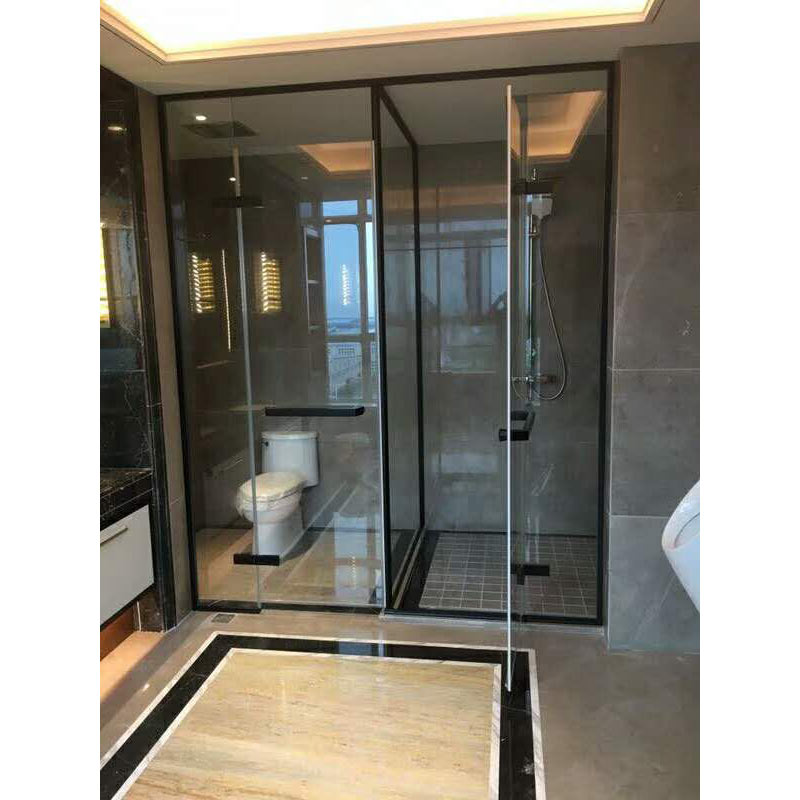
Sample and quotation requests for KL-AS5507310 and KL-AS5577310 can be submitted with project drawings and glass specifications.
Both hinge builds share the same glass craftsmanship options and the same applicable industries, so the material decision stays a genuine project decision rather than a limitation. Send your bathroom humidity conditions, framed or frameless preference and project type, and SHKL can confirm which hinge build fits, along with glass thickness, sample lead time and quotation: www.shklbathroom.com | info@shklbathroom.com.
Foshan SHKL Sanitary Ware Co., Ltd manufactures bathroom vanities, shower doors and LED bathroom mirrors, serving residential and commercial hospitality projects across the EU, Australia, North America, South America and the Middle East.
Have Questions or Need More Details?
Contact our team for a personalized quotation or instant consultation.
Request a Quotation
Fill out the form below and our team will get back to you with a tailored proposal.
WhatsApp Direct Chat
Prefer to chat in real-time? Message us on WhatsApp for instant assistance & quick answers.
- Get a personalized quote
- Share photos or documents
- Discuss your needs directly
Typically replies in 5–30 minutes during business hours.