
Bathroom Vanity Compliance Guide: Reading Product Specs for Regional Standards and Acceptance
A vanity specification sheet tells a reviewer what a product is. A compliance file tells them why it can be accepted. This guide shows specifiers how to read a bathroom vanity specification line by line — substrate, hardware, basin, LED mirror functions and mounting — and convert each line into the documentation and acceptance evidence a regional project may ask for.
Most sourcing problems in this category are not manufacturing problems. They appear later, when a specification written for one market is submitted to a reviewer in another and the document set behind it is thinner than the specification implies. The gap usually sits in five places: a material named without a declaration, a hardware brand named without a component schedule, a basin described without stating whether it is integral or undermounted, a mirror described as a feature list rather than a set of electrical functions, and a mounting type named without the fixing method that makes it work.
This guide is written for specifiers, importers, project buyers and procurement teams working at research and evaluation stage. It uses four models from Foshan SHKL Sanitary Ware Co., Ltd (SHKL) as worked examples and stays strictly on what the published specification states. SHKL is a manufacturer of bathroom vanities, shower doors and LED bathroom mirrors established in 2004, with production bases in China (100,000 m²) and Vietnam (40,000 m²). Where a project may require an approval that the available documentation does not evidence, this guide says so rather than assuming it.
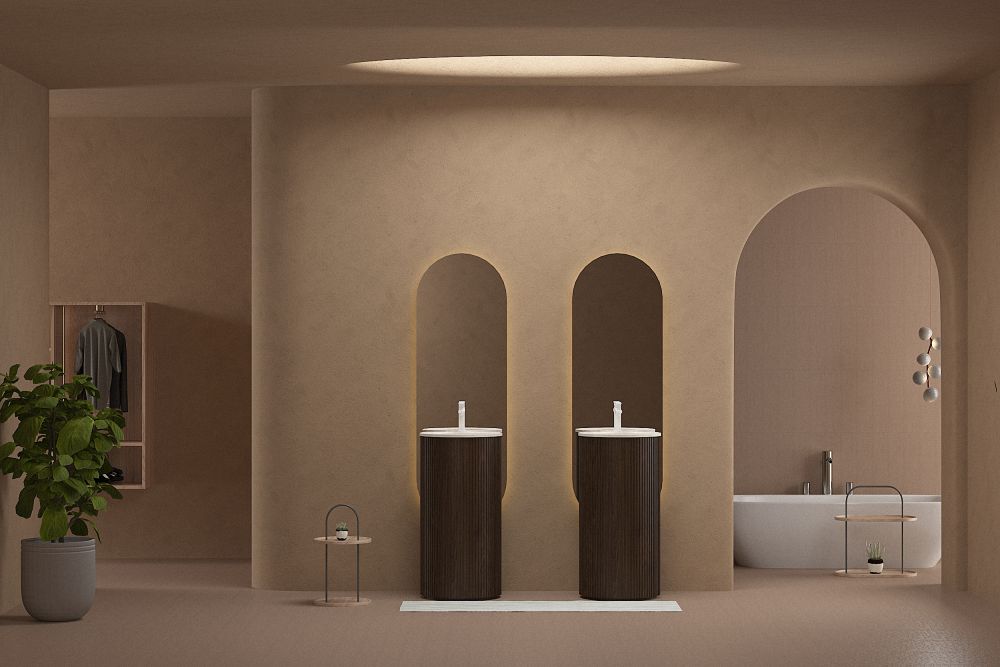
Problem definition: where vanity specifications break down at acceptance
The failure is structural rather than accidental. Specification sheets are written to describe a product; acceptance files are written to reduce risk. They use different language, and the translation step is usually missing from the purchase order.
Four patterns account for most of the friction:
- The material line names a material but not its evidence. “Plywood and solid wood” describes construction. It does not tell a reviewer which panel documentation exists, who issued it, or whether it covers the panels actually supplied on this order.
- The hardware line names a brand but not a component schedule. A reader sees DTC or Unihopper and assumes the schedule is settled. Acceptance depends on knowing which hinge, which slide and which opening mechanism sits on which door or drawer.
- The feature list is read as performance. “Three colour temperature, defog, dimmable” is a function description. A commissioning check needs the control type — touch buttons, motion sensor or infrared switch — recorded separately.
- Mounting is treated as a design choice instead of a structural dependency. Wall-mounted, floating and freestanding vanities load different parts of a building, and the fixing method is a project decision, not a product decision.
A fifth pattern is more expensive than the rest: treating a management system certificate as if it were a product certificate. That distinction is explained in full below.
Industry background: why spec reading has become a compliance task
The category is large enough that documentation practices are being pulled upward by procurement rather than by regulation alone. One commercial study places wood-based construction — solid wood and plywood — at 42.7% of bathroom vanity market revenue in 2025, which means the substrate question is the mainstream question, not a niche one. The same research identifies North America as the largest regional market and Asia Pacific as the fastest growing, with a 35% revenue share in 2023.
Market-size figures should not be carried into a project document. Available commercial estimates for the bathroom vanities category disagree materially on absolute value for overlapping years, and the sources reporting them either publish no visible methodology or are unresolved redirects. What survives that disagreement is direction: reported growth rates cluster between roughly 6.5% and 7.4%. For a specifier, the usable conclusion is narrow — the category is expanding and documentation expectations are tightening, but no single market figure belongs in a submittal.
Regional requirements differ in kind, not just in strictness. Some markets ask for panel-level emissions documentation, others for electrical evidence on illuminated mirrors, others for structural confirmation of how a wall-hung unit is fixed. Because the list is project-specific, the practical approach is to read the specification as a set of questions rather than a set of answers.
Dimensional conventions differ too. In North America, standard vanity height is commonly cited as 32–36 inches (813–914 mm), with 34.5 inches treated as a comfort height. That range is a useful cross-check but not a substitute for the project drawing.
The five spec clusters that decide whether a vanity can be accepted
1. The substrate and construction line
All four worked examples carry the same construction statement: plywood and solid wood. For a submittal, that single line splits into three questions — what the cabinet body is made of, what the visible surface is finished with, and whether the panel carries the emissions or formaldehyde documentation the destination market requires. A plywood bathroom vanity and a solid wood bathroom vanity specification may read identically on the sheet and behave differently in a review, because the documentation behind the panel differs.
2. The hardware schedule
Hardware is named by brand on these models: DTC hinges and DTC soft-closing slides, Unihopper soft-closing slides, a Hettich push-open system, and hidden handles. For acceptance, the brand is the beginning of the record. The schedule should state which component sits on which opening, whether the function is soft-close or push-open, and whether the delivered unit carries the named component.
3. The basin and countertop arrangement
Four different arrangements appear across the four examples: an undermount ceramic basin under a porcelain slab, a sintered stone integral basin, a sintered stone internal basin, and a glossy white ceramic basin. The distinction matters at inspection, because an integral basin is one piece with the top while an undermount basin is a joint between two components. The acceptance check is not the same for both.
4. The LED mirror functions
Mirror features convert directly into documentable functions, and they should be written as such: backlit, dimmable, defog, number of colour temperatures, and control type. AS813047 and AS813050 both provide three colour temperatures with two touch buttons; AS813049 provides one colour temperature with a motion sensor switch; KL813003 is specified as an LED mirror supporting different functions without itemising them, which means the mirror configuration has to be fixed in the order rather than assumed from the model number.
5. Mounting type and installation dependency
Wall-mounted and floating vanities transfer load to the wall; freestanding vanities transfer load to the floor. The model name tells a reviewer which category applies, but it does not evidence the fixing method. That is the line to confirm before the first unit is hung — particularly for wall mounted bathroom cabinets, where the wall build-up determines whether the specified fixing is appropriate.
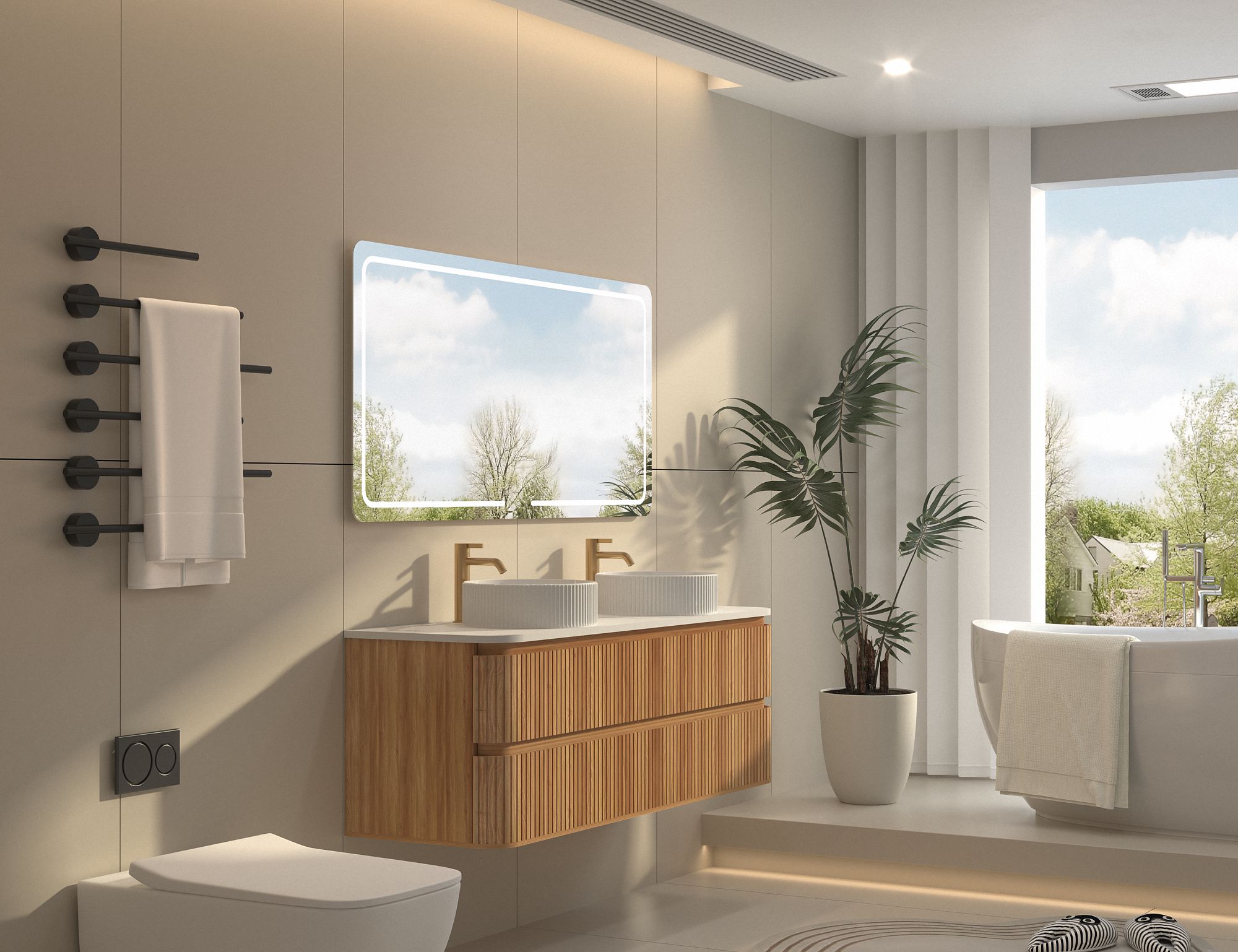
What SHKL's documented certification set covers — and what it does not
SHKL publishes three management system certificates, all issued by Guangdong Quality Testing CTC Certification Co., Ltd. and all valid from 11 May 2024 to 10 May 2027. The certificate records link them to model KL813003 and apply them to the global market, including China, the EU, the US and the Middle East.
| Certificate | Certificate number | Standard | Validity |
|---|---|---|---|
| Quality management system | 04924Q00629R0M | GB/T 19001-2016 / ISO 9001:2015 | 2024-05-11 to 2027-05-10 |
| Environmental management system | 04924E00351R0M | GB/T 24001-2016 / ISO 14001:2015 | 2024-05-11 to 2027-05-10 |
| Occupational health and safety management system | 04924S00316R0M | GB/T 45001-2020 / ISO 45001:2018 | 2024-05-11 to 2027-05-10 |
Three reading notes matter more than the certificate list itself.
These are management system certificates. ISO 9001 addresses quality management, ISO 14001 environmental management and ISO 45001 occupational health and safety management. They evidence how a manufacturer's processes are organised and audited. They do not certify that a specific vanity meets a specific product standard.
The scope statement is what a reviewer actually reads. The published scope covers research and development and the manufacture of bathroom cabinets, plus the manufacture of fixed universal lighting fixtures. The second half of that sentence is the part most specifiers miss — it is the link to LED mirror production, and a reviewer checking an illuminated mirror will look for it.
Dates and issuer are checkable facts. A certificate that expires before project handover is a live risk, and the issuing body's name and accreditation status should appear in the submittal exactly as printed.
Reading four model specs line by line
KL813003 — wall-mounted, the most fully dimensionalised specification
KL813003 is a wall mounted bathroom vanity in plywood and solid wood with an A2391 Acacia melamine and solid wood lacquered finish. It carries two drawers on DTC soft-closing slides with hidden handles, a Pure White Porcelain slab countertop and an undermount ceramic basin. It is the only one of the four with a published size range: 750 / 800 / 900 / 1000 / 1200 × 520 × 504 mm. The mirror line states an LED mirror supporting different functions without itemising them, so the mirror specification must be resolved in the order. Because it is a wall-mounted unit, the fixing method and wall build-up belong in the project file alongside the model code.
AS813047 — the model that shows why mount type must be confirmed
AS813047 is specified as plywood and solid wood with a Warm Mist Brown lacquered and melamine finish, two drawers on Unihopper soft-closing slides, and a sintered stone integral basin. Its LED mirror uses a light gold aluminium frame with 5 mm copper-free glass and provides three colour temperatures with defog and dimming on two touch switch buttons. The available specification does not state a mounting type for this model. That is not a defect in the product; it is a gap in the submittal, and it should be closed in writing before the model is presented as a wall-mounted or floating option.
AS813049 — freestanding, and the only one with mirror dimensions
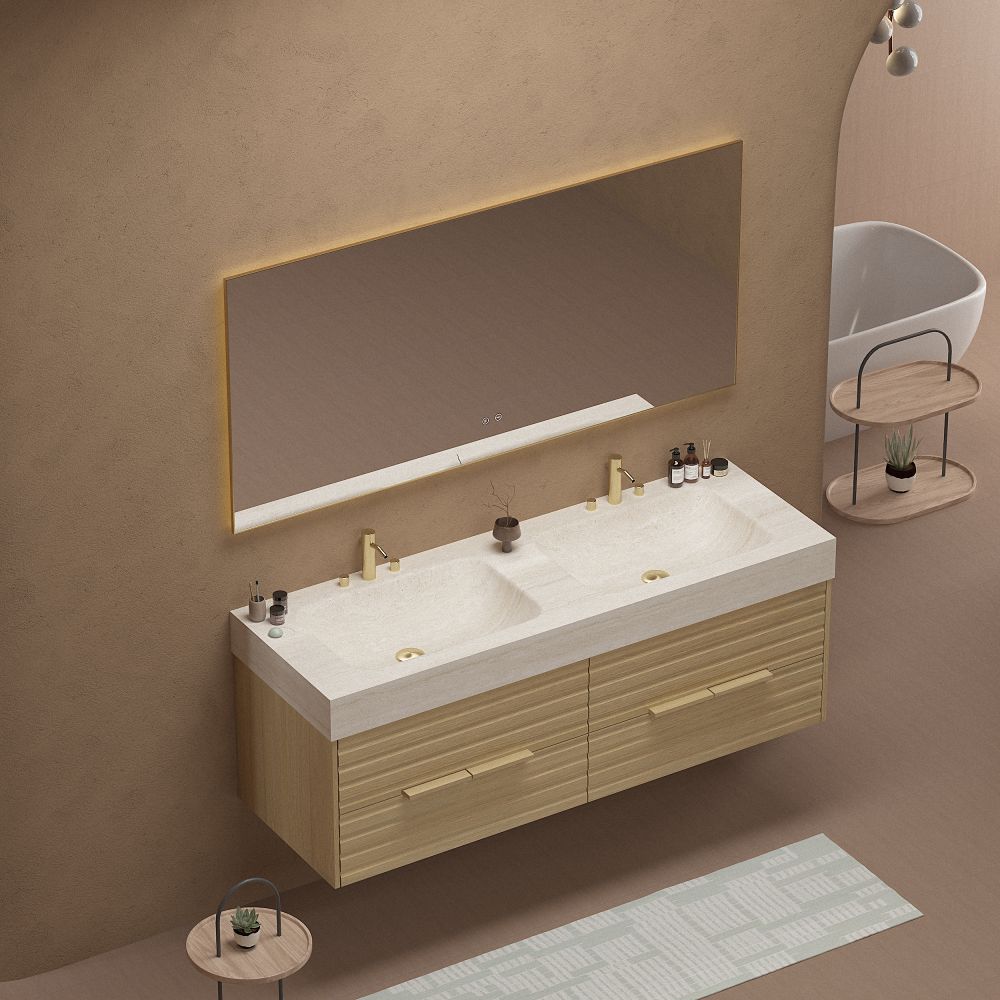
AS813049 is a freestanding bathroom vanity with a cabinet of 450 × 450 × 890 mm and an LED mirror of 500 × 1500 × 35 mm. The cabinet is plywood and solid wood with an Ancora Walnut lacquered and melamine finish and a single door on a DTC hinge with a Hettich push-open system. The basin is a sintered stone internal basin. The mirror uses a light gold metal frame with a motion sensor switch, one colour temperature, backlight, defog and dimming.
Two acceptance points follow from that record. First, a freestanding unit in this size class is the closest thing in the range to freestanding bathroom furniture, which means floor contact, levelling and stability belong in the installation check rather than the wall fixing check. Second, the mirror carries one colour temperature and a motion sensor — a different control logic from the two-button models, and one that should be commissioned separately.
AS813050 — floating, with the simplest cabinet schedule
AS813050 is a floating bathroom vanity in plywood and solid wood with an Ancora Walnut lacquered and melamine finish. It has one drawer on Unihopper soft-closing slides, a glossy white ceramic basin, and an LED mirror in a gun metal frame with three colour temperatures, defog, dimming and two control buttons. As with AS813047, the available specification does not publish cabinet dimensions, so the dimensional line must be confirmed for a project that depends on it. As a floating installation, the wall fixing and the concealed support are the acceptance-critical items.
Step-by-step breakdown: from spec line to acceptance criteria
- Copy the specification verbatim into the submittal. Do not paraphrase “plywood and solid wood” into “wood construction”, and do not shorten “sintered stone integral basin” into “stone top”. Paraphrase is where traceability is lost.
- Attach a compliance question to each line. Every material, component and function statement should have one question beside it in the review file: what document would answer this if a reviewer asked?
- Separate single-source from multi-source items. A sintered stone integral basin removes a joint. An undermount ceramic basin under a porcelain slab introduces one. The number of suppliers behind a line is a risk indicator, and it belongs in the evaluation, not the invoice.
- Fix the mirror configuration and the mounting method in writing. These are the two lines most often left open. Colour temperature count, defog, dimming and control type should be stated per model; mounting type and fixing method should be stated per installation.
- Request the certificate set in a fixed format. Ask for seven fields per certificate: full certificate name, standard number and year, certificate number, issuing body, scope statement, issue date, expiry date. Add the accreditation status of the issuing body if the project requires it.
- Check documents against the delivery, not the brochure. A 100% inspection regime, as stated in the manufacturer's OEM capability record, produces inspection evidence. Ask what that evidence looks like at handover.
- Record the gaps explicitly. “Not stated in the available specification” is a legitimate submittal entry. It is far cheaper than a discovery at installation.
| Spec line | Document to request | Acceptance check |
|---|---|---|
| Substrate: plywood and solid wood | Panel declaration naming the substrate, plus the emissions or formaldehyde document the destination market requires | Delivered substrate matches the approved sample; declaration covers the panel supplied |
| Hardware: DTC, Unihopper, Hettich | Component schedule by opening type, with brand and function confirmed | Hinges, slides and push-open units match the schedule; soft-close operates on the delivered unit |
| Basin and top: ceramic, sintered stone, porcelain slab | Material name as specified, with integral versus undermount clearly stated | Basin arrangement matches the approved drawing; integral units show no joint |
| LED mirror: dimmable, defog, colour temperature | Electrical and function documentation for the delivered mirror, including control type | Dimmable, defog and colour-temperature functions verified at commissioning |
| Mounting: wall mounted, floating, freestanding | Fixing schedule and wall or floor build-up confirmation | Fixing method signed off before the first unit is installed |
Use cases: how the procedure plays out on real project types
US hotel bathroom project — 250 units over a two-year programme
A US hotel project of 250 customized bathroom furniture units ran over two years. The project record states on-time delivery, product quality meeting US market standards, and high customer satisfaction, with design fidelity and requirement matching cited as highlights. In compliance terms, the useful lesson is where the evidence has to sit: a claim that a product meets US market standards is only as strong as the documentation attached to the specific material batch. For a programme of this type, request the panel declaration, the hardware schedule and the mirror electrical documentation before the first shipment rather than at handover.
Australian villa project — 100 units of OEM bathroom furniture
A villas project in Australia used 100 units of OEM bathroom furniture. The record cites compliance with villa design specifications, on-time delivery and high satisfaction, with durability, practicality and a coherent overall style as the highlights. Villa work usually puts the emphasis on finish and consistency between units, which is exactly where a lacquered finish line and a repeatable hardware schedule matter more than a single show sample.
Canadian bathroom and kitchen cabinetry — 50 units
A Canadian client ordered 50 units across bathroom and kitchen cabinetry. The record states that materials met requirements and that products met Canadian safety standards, with on-time delivery and high satisfaction. Mixed-category orders are a reminder that panel documentation can cover more than one product line, which simplifies the submittal if the substrate is the same.
Comparison table: four models, spec by spec
The table below reproduces only what the published specifications state. Entries marked as not stated should be treated as open items in a submittal, not as absences in the product.
| Item | KL813003 | AS813047 | AS813049 | AS813050 |
|---|---|---|---|---|
| Mount type as stated | Wall mounted bathroom vanity | Not stated in the available specification | Freestanding bathroom vanity | Floating bathroom vanity |
| Substrate and finish | Plywood and solid wood; A2391 Acacia melamine and solid wood lacquered | Plywood and solid wood; Warm Mist Brown lacquered and melamine | Plywood and solid wood; Ancora Walnut lacquered and melamine | Plywood and solid wood; Ancora Walnut lacquered and melamine |
| Hardware and openings | Two drawers, DTC soft-closing slides, hidden handle | Two drawers, Unihopper soft-closing slides | One door, DTC hinge, Hettich push-open system | One drawer, Unihopper soft-closing slides |
| Basin and top | Pure White Porcelain slab countertop; undermount ceramic basin | Sintered stone integral basin | Sintered stone internal basin | Glossy white ceramic basin |
| LED mirror functions | LED mirror supporting different functions, not itemised | Light gold aluminium frame, 5 mm copper-free glass, three colour temperatures, defog, dimmable, two touch buttons | Light gold metal frame, motion sensor switch, one colour temperature, backlit, defog, dimmable | Gun metal frame, three colour temperatures, defog, dimmable, two control buttons |
| Dimensions on record | 750 / 800 / 900 / 1000 / 1200 × 520 × 504 mm | Not stated in the available specification | Cabinet 450 × 450 × 890 mm; mirror 500 × 1500 × 35 mm | Not stated in the available specification |
The same reading method applies whether the specification covers a single bathroom vanity for a compact refurbishment or a double sink bathroom vanity in a hotel programme. What changes is the volume of documentation, not its structure.
FAQ
How do I confirm that a bathroom vanity manufacturer supports CARB-compliant work for a US project?
CARB requirements sit at panel and material level, so the evidence has to come from the panel supply chain, not from a general company certificate. Ask the manufacturer for the specific composite panel declaration, the mill-level documentation the project requires, and a test record tied to the panel supplier and batch used for your order. For reference, the certification set SHKL publishes consists of ISO 9001:2015 (certificate 04924Q00629R0M), ISO 14001:2015 (04924E00351R0M) and ISO 45001:2018 (04924S00316R0M), issued by Guangdong Quality Testing CTC Certification Co., Ltd. and valid from 11 May 2024 to 10 May 2027. These are management system certificates covering R&D and the manufacture of bathroom cabinets plus the manufacture of fixed universal lighting fixtures. They do not by themselves certify a product's formaldehyde performance, so panel-level documentation should be requested per project and confirmed in writing.
What can a manufacturer customise, and what production scale should a project expect?
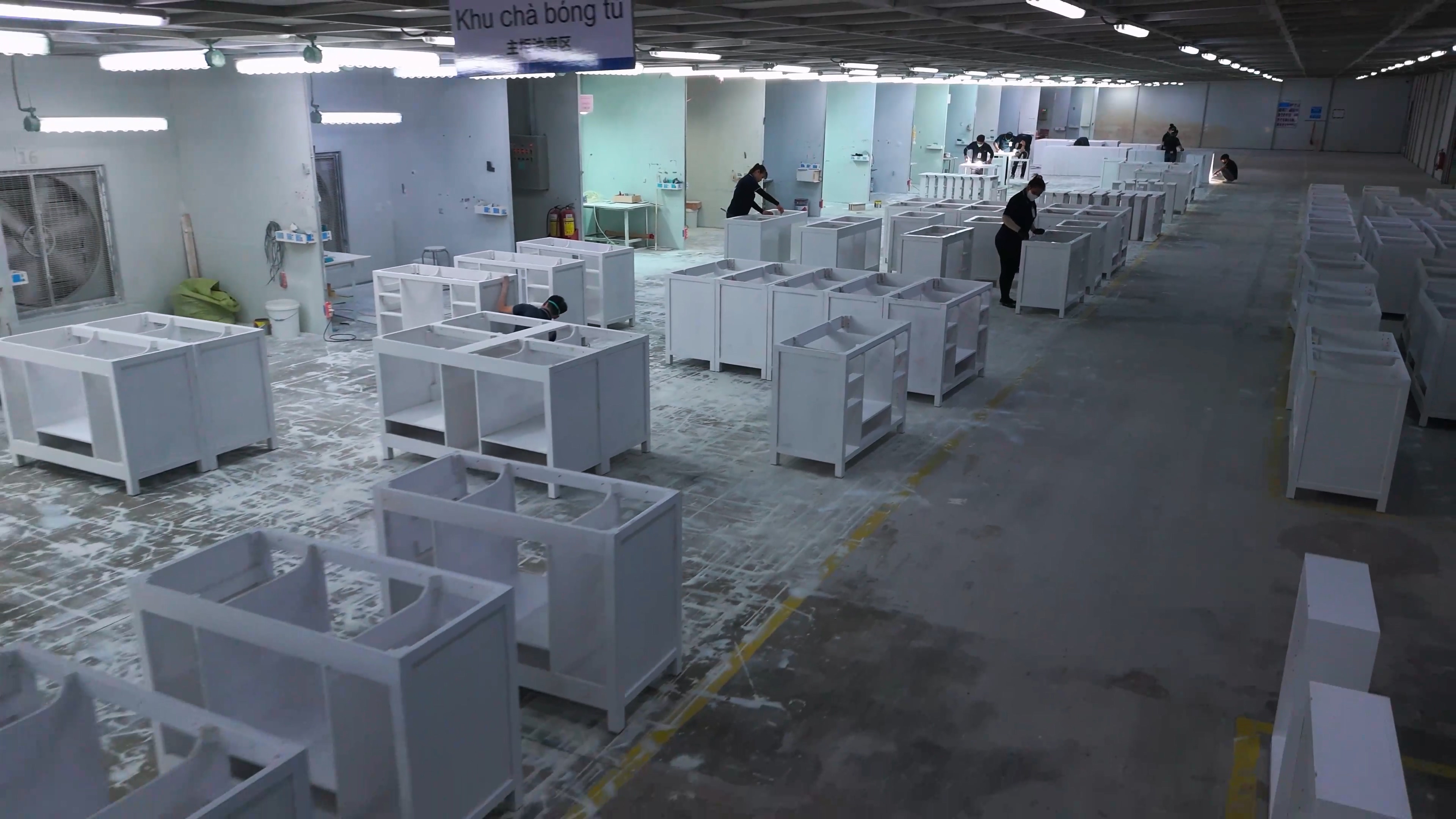
SHKL's OEM capability record lists customisation across size, colour, material, finish, hardware, logo and design style, with a stated monthly capacity of 10,000, a minimum order quantity of 50 and 100% inspection. The company profile reports a China production base of 100,000 m² and a Vietnam base of 40,000 m², with monthly output of more than 70,000 units across bathroom cabinets, shower enclosures and LED mirrors and an export share of 70%, serving the EU, AU, NA, SA and ME markets. Two production locations are relevant to compliance work as well as to capacity, because the origin of a shipment can change which documentation a market requires.
What drives the price difference between two vanities with the same footprint?
No price bands are published for these models, so the honest answer is that cost follows the bill of materials, and the bill of materials is visible in the specification. The lines that differ between otherwise comparable models are substrate and finish, hardware family, basin and top arrangement, and mirror functions. For scale, KL813003 uses a Pure White Porcelain slab countertop with an undermount ceramic basin, AS813047 and AS813049 use sintered stone basins, and AS813050 uses a glossy white ceramic basin with the simplest single-drawer cabinet in the group. Mirror function count adds another variable: three colour temperatures with defog and dimming on two touch buttons is a different configuration from one colour temperature on a motion sensor switch. A quote should be requested against a fixed specification so those lines are priced explicitly.
How should a sample be used to validate a specification?
A sample validates finish, function and fit; it does not replace material test documentation. Check the sample against the specification line rather than against a rendering: confirm the substrate statement, confirm the hardware brand on each opening, confirm whether the basin is integral or undermounted, operate the mirror through every function it is specified to have, and confirm the mounting type before the sample is approved. Request the same document set with the sample that will accompany production.
What lead time should a project schedule assume?
The OEM capability record states a production lead time of 30–45 days with a minimum order quantity of 50. That figure covers production, not the documentation cycle in front of it, so a realistic schedule adds sample approval and document review before production release. The company profile notes that the Vietnam facility was established partly to shorten lead times and improve supply resilience for North American clients. For a specification review, quote request or the product catalogue, contact the team at shklbathroom.com.
Conclusion
Compliance in this category is not decided by a single certificate. It is decided by whether each line of the specification can be traced to a document, and whether that document covers the model, the batch and the market in front of the reviewer. The four models reviewed here show how much variation hides inside a short spec sheet — a wall-mounted unit with a published size range, a freestanding unit with mirror dimensions, a floating unit with a single drawer, and a model whose mounting type is simply not stated. Reading those differences early is the cheapest form of risk management available to a specifier.
Start with the substrate and hardware lines, resolve the mirror configuration and mounting method in writing, and request the certificate set in a fixed seven-field format so that nothing depends on interpretation. Where evidence is missing, record the gap rather than filling it with an assumption.
Request the specification pack
The SHKL product catalogue covers bathroom vanities, shower doors and LED bathroom mirrors, with model specifications, materials and finishes. Download it, or send a project specification for a line-by-line documentation review and quotation.

Download the SHKL product catalogue (PDF)
Email: info@shklbathroom.com / info@shkl.cc · WhatsApp: +86 13790005061 · Website: www.shklbathroom.com
Have Questions or Need More Details?
Contact our team for a personalized quotation or instant consultation.
Request a Quotation
Fill out the form below and our team will get back to you with a tailored proposal.
WhatsApp Direct Chat
Prefer to chat in real-time? Message us on WhatsApp for instant assistance & quick answers.
- Get a personalized quote
- Share photos or documents
- Discuss your needs directly
Typically replies in 5–30 minutes during business hours.