
What Is a Floating Bathroom Vanity? Space-Saving Design and Modern Features Explained
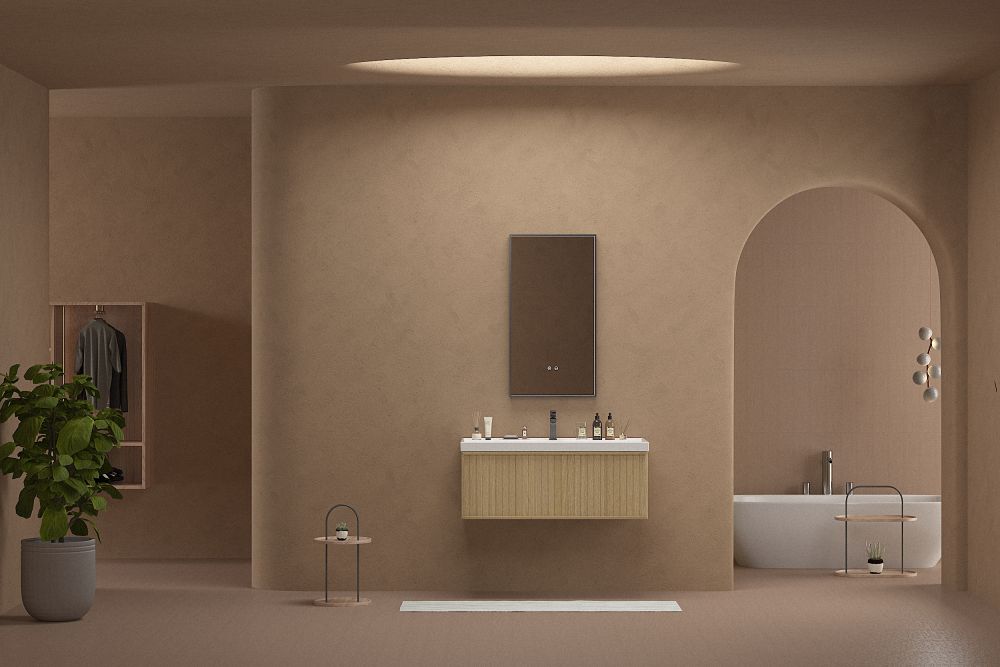
A floating bathroom vanity is a vanity cabinet that is fixed to the wall instead of standing on legs, a plinth or a base unit, so the floor beneath the cabinet stays visible. The mount changes the visual weight of the room and how the floor is cleaned, but it does not change what the cabinet is made of. In the SHKL range, floating models such as AS813050, AS813048A, AS813108 and AS813109 all use plywood and solid wood cabinets with lacquered and melamine finishes, soft-close drawer hardware and, on selected models, LED mirrors with dimming and defog functions.
This explainer covers how the category is constructed, what the space-saving argument actually depends on, how a floating unit is specified step by step, and which model-level details buyers should compare before approaching a bathroom vanity manufacturer for a quotation.
What "Floating" Actually Means
Floating describes the mounting method, not the style, the material or the price band. A floating vanity is anchored to the wall so the cabinet body hangs above the floor and the floor line runs uninterrupted beneath it.
Product data shows the two labels in everyday use. AS813109 and AS813050 are catalogued as floating bathroom vanities, AS813048A is described as designed for wall-mounted installation, and KL813003 is catalogued as a wall mounted bathroom vanity within the wall mounted bathroom cabinet category. All of them are wall-fixed cabinets; the difference in label reflects how the range is organised rather than two different fixing principles.
What floating does not change is the specification list underneath the label. Cabinet material, finish, drawer structure, hardware, countertop, basin and mirror remain separate decisions. A floating vanity can therefore carry the same storage and surfacing as a floor-standing unit — AS813109, for example, combines two side drawers with one outer drawer and one inner drawer, a terrazzo countertop and a solid surface basin inside a wall-hung cabinet.
The Problem Floating Vanities Solve
The category exists because bathroom floor area is usually the scarcest dimension in a renovation. A floor-standing cabinet occupies the floor under the basin; a wall-fixed cabinet releases it. Three practical consequences follow.
Perceived space. When the cabinet stops short of the floor, the visible floor area reads as larger than it measures. In compact bathrooms the effect is usually the main reason a buyer moves from a freestanding unit to a floating one.
Cleaning access. A continuous floor under the vanity can be cleaned without working around legs or a plinth, and there is no base for water and dust to collect against.
Storage retained rather than reduced. Floating does not mean fewer drawers. Storage moves into drawer stacks and door compartments within the cabinet body, which is why drawer count and hardware quality carry more weight on a wall-hung unit than on a floor-standing one.
Project data shows the same three needs appearing in commercial installations. SHKL's hotel and villa application records list storage organisation, bathroom space optimisation and wet-dry separation support as the functions a bathroom cabinet has to deliver, and list moisture-proof, mildew-resistant and scratch-resistant performance as the special requirements for those projects.
One constraint follows directly from the mount: because the cabinet hangs, load is carried by the wall, so the wall build-up and the fixing method have to be confirmed on site before the unit enters a fixed installation programme.
Industry Background: Why Wood Construction Still Leads
Floating vanities sit inside a wood-dominated category. Wood materials — solid wood and plywood — held a 42.7% revenue share of the bathroom vanities market in 2025, according to Data Bridge Market Research. That matters for specifiers because the substrate decision is not a niche option but the mainstream one, and the finish and edge treatment applied to that substrate is what decides how the surface behaves in a wet room.
Growth signals point in one direction even where absolute figures do not. Commercial research studies on bathroom vanities report compound annual growth rates clustering between roughly 6.5% and 7.4%, while their market-value figures for overlapping years differ materially because product scope is defined differently between reports. The growth rate is therefore usable as a directional signal; any single headline market value should be checked against its own methodology before it is quoted in a procurement document.
Regional structure is more stable. North America is identified as the largest market for bathroom cabinets, with Asia Pacific the fastest-growing region at a 35% revenue share in 2023 (Grand View Research). Supply follows demand. Foshan SHKL Sanitary Ware Co., Ltd. (SHKL), a China-based bathroom vanity manufacturer founded in 2004, operates a 100,000 m² production base in China and a 40,000 m² factory in Ho Chi Minh City, Vietnam, with roughly 70% of output exported to the EU, Australia, North America, South America and the Middle East.
Construction Features: How a Bathroom Vanity Manufacturer Builds a Floating Unit
Cabinet Material: Plywood and Solid Wood
Every floating model in the current SHKL line specifies a plywood and solid wood cabinet. AS813050, AS813048A, AS813108, AS813109 and AS813047 share that material combination, and the same combination appears on the freestanding AS813049 and the wall mounted KL813003. Because the published specification does not split which components are plywood and which are solid wood, buyers who need that split for a tender document should request it in writing rather than assume it.
Finish: Lacquered Faces and Melamine Surfaces
The finish specification pairs two systems inside one model code. Ancora Walnut lacquered and melamine is used on AS813050 and AS813049; Warm Mist Brown lacquered and melamine on AS813048A, AS813108, AS813109 and AS813047; A2391 Acacia melamine with solid wood lacquered on KL813003. Read literally, a model carries both a sprayed lacquer finish and a melamine-faced surface, so the useful question for a buyer is which faces receive which treatment, not which single finish the model uses.
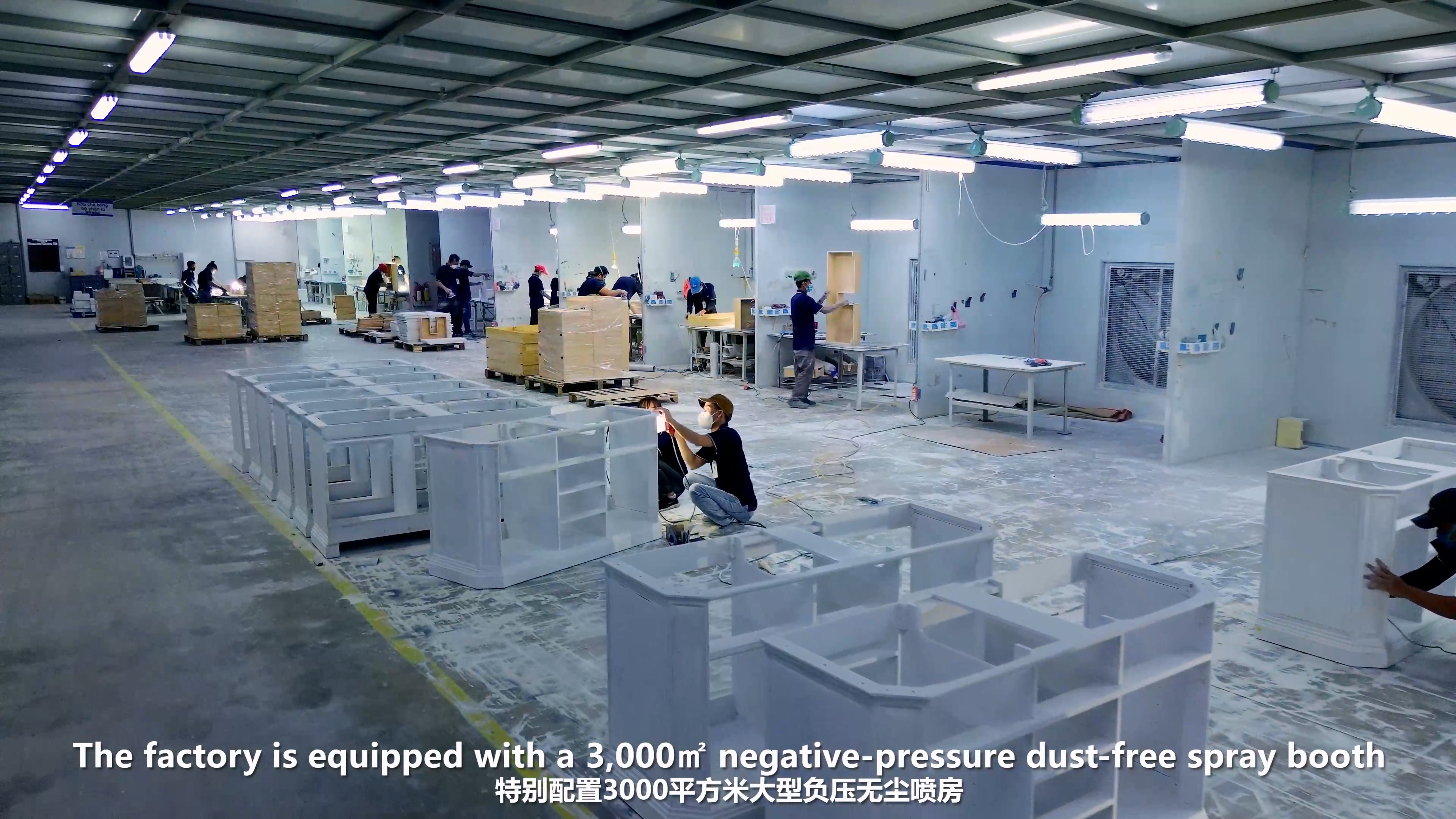
Surface quality is decided at the coating stage. SHKL operates a PU dust-free spray paint workshop at its Vietnam factory for surface treatment, and inspection of semi-finished products takes place during the spraying process rather than only at final assembly.
Hardware and Drawer Structures
Hardware is where a floating vanity is judged day to day, because a wall-hung cabinet has no floor contact to absorb movement or misalignment. Published configurations include Unihopper soft-close slides on AS813050, AS813108, AS813109 and AS813047; Unihopper metal box soft-close slides on AS813048A; Unihopper push-open slides with DTC hinges and a Hettich push-open system on KL813001; DTC soft-close slides with a hidden handle on KL813003; and a DTC hinge with a Hettich push-open system on the freestanding AS813049.
Drawer count is a specification decision rather than a quality ranking. AS813050 carries one drawer, AS813048A and AS813108 carry two, and AS813109 layers two side drawers with an outer and an inner drawer for a deeper storage stack.
Countertops and Basins
Top and basin materials vary across the range. AS813109 uses a terrazzo countertop with a solid surface basin; AS813108 uses a solid surface countertop with a ceramic basin; AS813050 and AS813048A use a glossy white ceramic basin; AS813049 and AS813047 use sintered stone integral basins; KL813003 uses a Pure White Porcelain slab countertop with an undermount ceramic basin; KL813001 pairs a Pure White Porcelain slab with an above-counter ceramic basin.
Integrated LED Mirrors and Modern Features
Modern features in this category concentrate in the mirror rather than in the cabinet. AS813050 pairs the vanity with a gun metal frame LED mirror offering three colour temperatures, a defog function and dimming through two control buttons. AS813108 uses a mirror cabinet with three doors on DTC hinges, an internal LED light strip and an infrared sensor switch. AS813109 uses an oval mirror cabinet in 3 mm copper-free glass with matched cabinet and mirror sizing. AS813047 uses a light gold aluminium frame with 5 mm copper-free glass, three colour temperatures, defog and dimming via two touch switches. AS813049 moves control to a motion sensor with one colour temperature and a backlit surface, retaining defog and dimming.
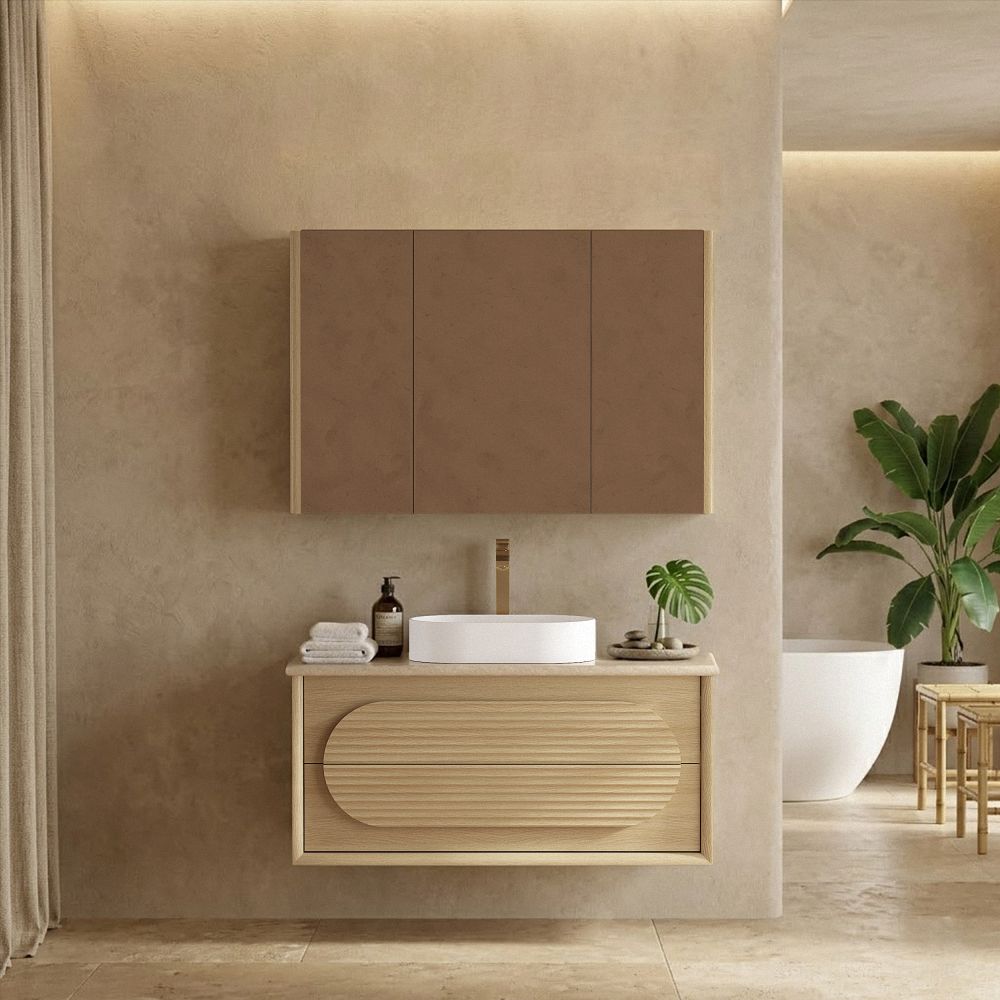
For buyers, the practical distinction is between a lit mirror, which provides illumination only, and a mirror cabinet, which adds enclosed storage. Both appear in the range, and neither is automatically the higher specification — the choice depends on whether the project needs storage above the basin or simply light.
Step-by-Step: Specifying a Floating Vanity
Step 1 — Confirm the installation and the wall. Establish that the project is a wall-fixed installation and confirm the wall build-up and fixing method before model selection, since the cabinet load is carried by the wall.
Step 2 — Fix the cabinet material and finish. Start from plywood and solid wood as the base specification, then confirm which faces receive the lacquered finish and which receive the melamine surface. Finish names in the range — Ancora Walnut, Warm Mist Brown, A2391 Acacia, A2392 Walnut — are model-level identifiers, so match them to the exact model code.
Step 3 — Choose the storage structure and hardware. Decide drawer count first (one drawer on AS813050, two on AS813048A and AS813108, a four-part drawer stack on AS813109), then confirm the slide and hinge system, since soft-close slides and push-open systems are specified per model.
Step 4 — Select the countertop and basin. Countertop options in the range include terrazzo, solid surface and Pure White Porcelain slab; basin options include ceramic, solid surface and sintered stone integral basins. Above-counter and undermount basin positions both appear, so the basin position must be fixed at the same time as the top.
Step 5 — Decide the mirror and lighting functions. Confirm whether the project needs a lit mirror or a mirror cabinet, then select functions: dimming, defog, single or three colour temperatures, touch-button, infrared or motion-sensor control, and frame finish.
Step 6 — Verify dimensions and project requirements. AS813109 is available with an 800 × 469 × 408 mm or 900 × 469 × 408 mm cabinet and a matched 800 × 650 × 150 mm or 900 × 650 × 150 mm LED mirror; AS813049 uses a 450 × 450 × 890 mm cabinet with a 500 × 1500 × 35 mm mirror; KL813003 is offered in 750, 800, 900, 1000 and 1200 mm widths at 520 × 504 mm. Height is usually set against local practice — North American vanity heights are commonly cited at 32–36 inches (813–914 mm), with 34.5 inches described as a comfort height in commercial sourcing guidance. Finally, confirm the project requirements for moisture, mildew and scratch resistance, then request quotation or sample documentation.
Use Cases: Where Floating Vanities Fit
Hotel bathrooms. A US hotel project in SHKL's application records uses KL813003, a wall mounted bathroom vanity, for storage organisation, space optimisation and wet-dry separation support, with moisture-proof, mildew-resistant and scratch-resistant performance listed as the special requirement. Housekeeping access to the floor beneath the cabinet is the operational reason wall-fixed units are common in this setting.
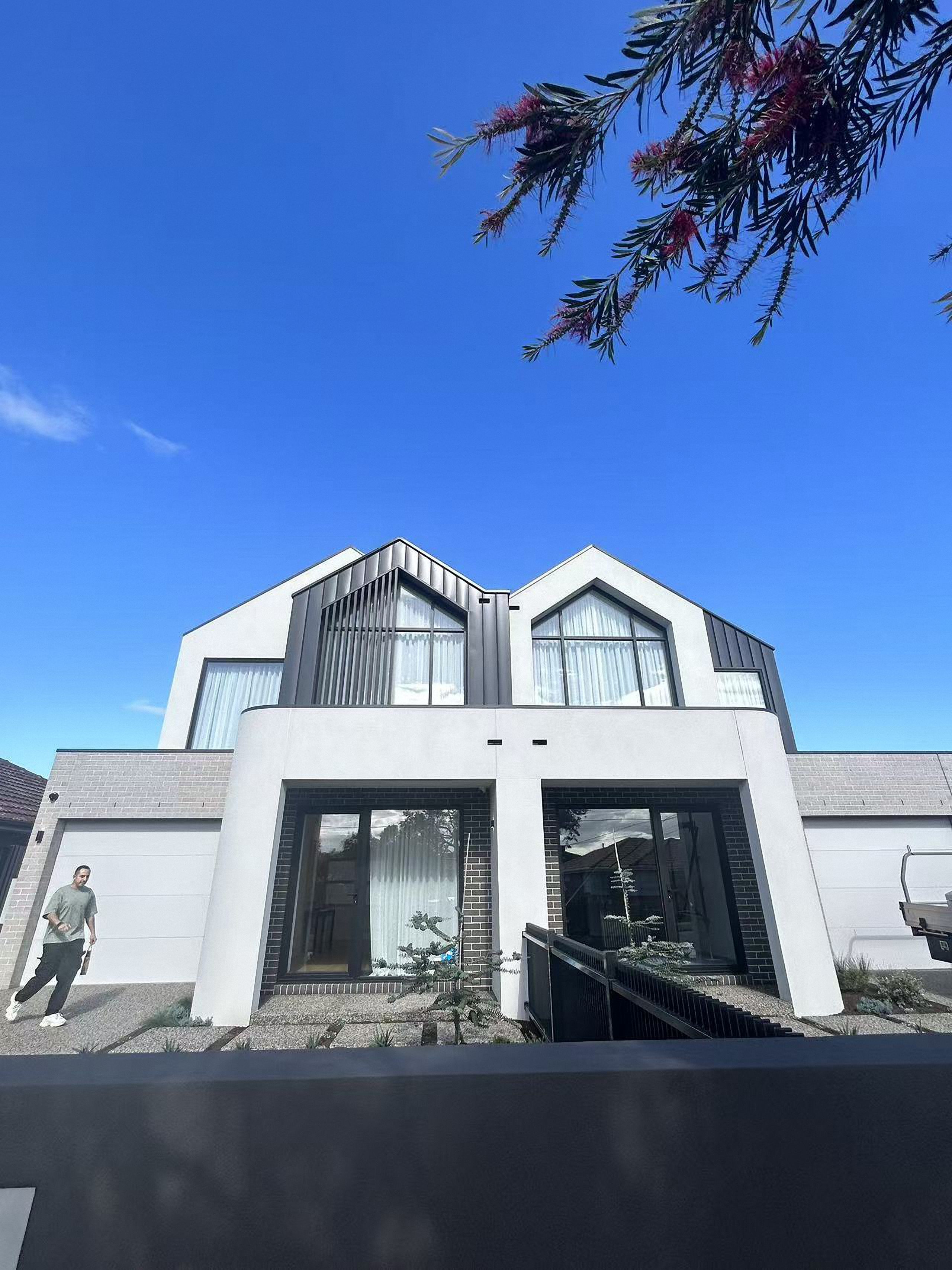
Residential villas and apartments. An Australian villa case in the same records uses the same wall-fixed logic in a residential bathroom, where the visible floor line and drawer storage matter more than the cabinet footprint.
Compact renovations. Where the bathroom is narrow, a floating single-vanity configuration keeps the floor reading continuous and allows the basin, mirror and storage to sit within one vertical zone.
Modern bathroom schemes. Because mirror functions, frame finishes and lacquered surfaces are specified per model, floating units adapt to both warm walnut-tone interiors and lighter lacquered schemes without changing the cabinet construction.
Model Comparison: Floating and Related Vanities in the SHKL Range
The table below compares model-level facts only, drawn from published product specifications. It is intended as a specification reference, not a ranking.
| Model | Mount type | Material and finish | Storage and hardware | Top and basin | Mirror |
|---|---|---|---|---|---|
| AS813050 | Floating | Plywood and solid wood; Ancora Walnut lacquered and melamine | One drawer; Unihopper soft-close slides | Glossy white ceramic basin | Gun metal frame LED mirror; three colour temperatures, defog, dimmable, two control buttons |
| AS813048A | Floating, wall-mounted installation | Plywood and solid wood; Warm Mist Brown lacquered and melamine | Two drawers; Unihopper metal box soft-close slides | Glossy white ceramic basin | Wooden frame mirror, no integrated lighting |
| AS813108 | Floating | Plywood and solid wood; Warm Mist Brown lacquer and melamine | Two drawers; Unihopper soft-close slides | Solid surface top; ceramic basin | Three-door mirror cabinet, DTC hinges, internal LED light strip, infrared sensor switch |
| AS813109 | Floating | Plywood and solid wood; Warm Mist Brown lacquer and melamine | Two side drawers plus one outer and one inner drawer; Unihopper soft-close slides | Terrazzo countertop; solid surface basin | Oval mirror cabinet, 3 mm copper-free glass; cabinet 800 × 469 × 408 mm or 900 × 469 × 408 mm, LED mirror 800 × 650 × 150 mm or 900 × 650 × 150 mm |
| AS813049 | Freestanding | Plywood and solid wood; Ancora Walnut lacquered and melamine | One door; DTC hinge with Hettich push-open system | Sintered stone integral basin | Light gold metal frame, motion sensor, one colour temperature, backlit, defog, dimmable; cabinet 450 × 450 × 890 mm, mirror 500 × 1500 × 35 mm |
| KL813003 | Wall mounted | Plywood and solid wood; A2391 Acacia melamine and solid wood lacquered | Two drawers; DTC soft-close slides, hidden handle | Pure White Porcelain slab top; undermount ceramic basin | LED mirror supporting different functions; sizes 750/800/900/1000/1200 × 520 × 504 mm |
FAQ
Are floating bathroom vanities suitable for humid bathroom environments?
Material and surface treatment decide suitability more than the mount type. SHKL floating vanities use plywood and solid wood cabinet bases with lacquered and melamine finishes, and the company's hotel and villa application records list moisture-proof, mildew-resistant and scratch-resistant performance as the special requirements for bathroom cabinet use. Because the cabinet is wall-hung, the wall build-up and fixing method also need to be confirmed before installation.
Which LED mirror functions are available on floating vanities?
Functions are specified per model. AS813050 uses a gun metal frame LED mirror with three colour temperatures, defog and dimming controlled by two buttons. AS813108 uses a three-door mirror cabinet on DTC hinges with an internal LED light strip and an infrared sensor switch. AS813109 uses an oval mirror cabinet in 3 mm copper-free glass, and AS813047 uses a light gold aluminium frame with 5 mm copper-free glass, three colour temperatures, defog, dimming and two touch switches.
How much storage does a floating vanity provide?
Storage is set by the drawer and door configuration rather than by the mount type. AS813050 has one drawer on Unihopper soft-close slides; AS813048A and AS813108 have two drawers; AS813109 combines two side drawers with one outer and one inner drawer; KL813003 has two drawers on DTC soft-close slides with a hidden handle.
How should buyers evaluate bathroom vanity manufacturers?
Start from verifiable production facts rather than product photography. Foshan SHKL Sanitary Ware Co., Ltd. was established in 2004 and operates a 100,000 m² production base in China plus a 40,000 m² factory in Ho Chi Minh City, Vietnam, with approximately 600 staff, a 20-engineer R&D team, monthly output of about 70,000 units and distribution to more than 50 countries, with around 70% of sales exported to the EU, Australia, North America, South America and the Middle East. Buyers should then compare material specification, hardware brand, drawer structure and mirror functions model by model.
How can buyers obtain model specifications for a floating vanity project?
Model-level specifications for AS813050, AS813048A, AS813108, AS813109, AS813049 and KL813003 can be requested directly from SHKL by email at info@shklbathroom.com or info@shkl.cc, by WhatsApp at +86 13790005061, or through www.shklbathroom.com. The product brochure linked at the end of this article is the practical starting point for a specification or quotation discussion on a floating vanity programme.
Conclusion
A floating bathroom vanity is defined by its wall-fixed construction, but it is specified by everything underneath that label: plywood and solid wood cabinet construction, a lacquered and melamine finish system, soft-close drawer hardware, a countertop and basin pairing, and a mirror decision that ranges from an unlit wooden frame to a three-colour-temperature LED mirror with defog and dimming. The space-saving argument is real, and it holds only when storage, hardware and wall fixing are resolved at the same time as the visual line.
For projects moving from awareness into evaluation, the efficient next step is to fix the model code and read its specification column by column, then confirm the points the specification does not split — such as which cabinet components are plywood and which are solid wood.
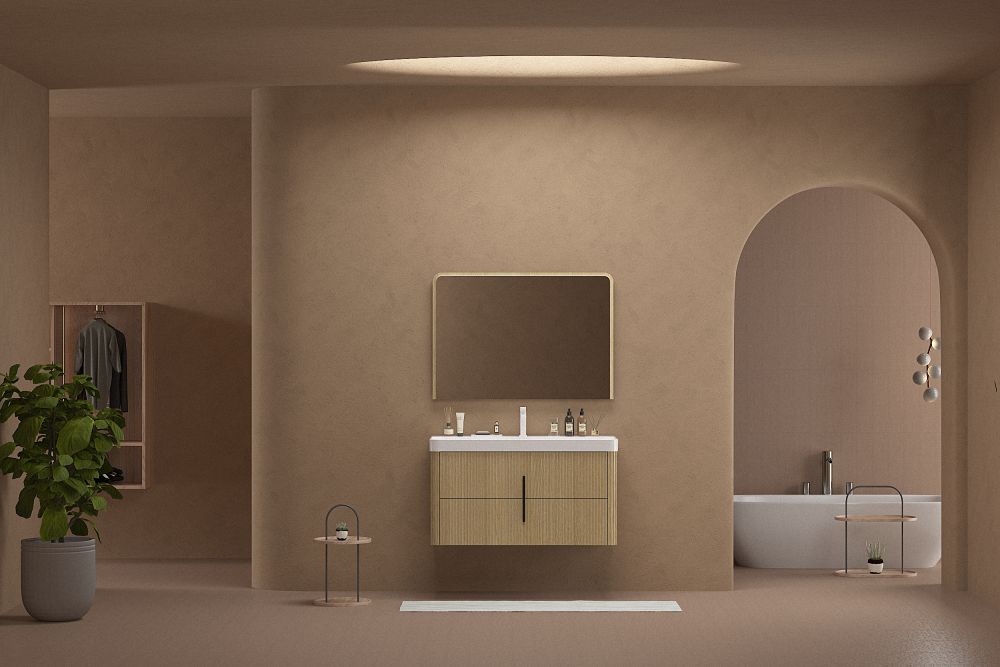
Next step: specification, sample and quotation
SHKL supplies bathroom vanities, shower doors and LED bathroom mirrors from production bases in China and Vietnam, with roughly 70% of output exported to the EU, Australia, North America, South America and the Middle East.
Download the product brochure: SHKL Bathroom Product Brochure (PDF)
Contact: email info@shklbathroom.com or info@shkl.cc · WhatsApp +86 13790005061 · website www.shklbathroom.com
Have Questions or Need More Details?
Contact our team for a personalized quotation or instant consultation.
Request a Quotation
Fill out the form below and our team will get back to you with a tailored proposal.
WhatsApp Direct Chat
Prefer to chat in real-time? Message us on WhatsApp for instant assistance & quick answers.
- Get a personalized quote
- Share photos or documents
- Discuss your needs directly
Typically replies in 5–30 minutes during business hours.