
Bathroom Vanity Mount Types: Residential & Hospitality Selection Guide
Bathroom Vanity Mount Types: Residential & Hospitality Selection Guide
Application guide for specifiers, contractors and procurement teams · SHKL · October 2026
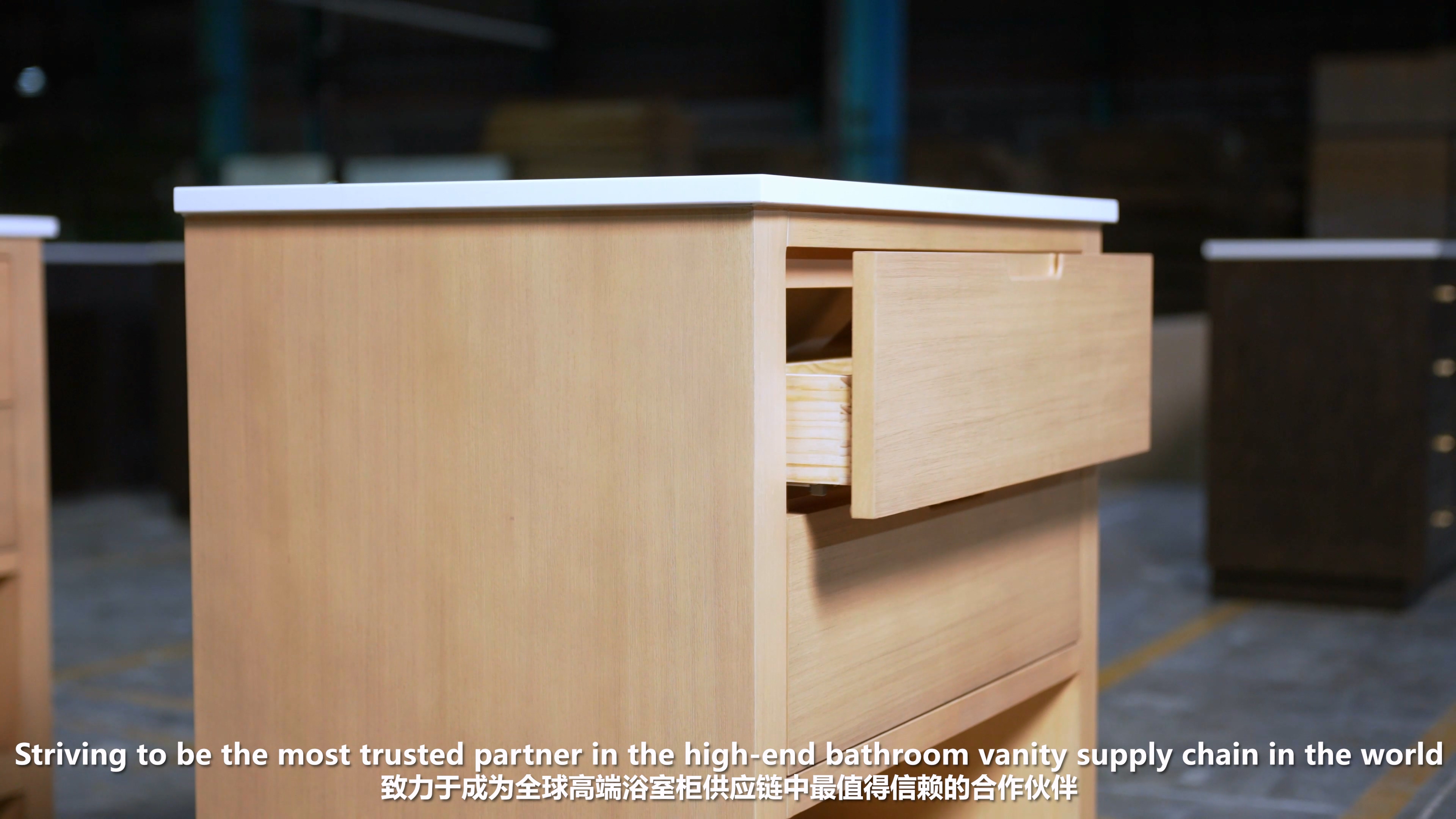
Finished bathroom vanity units at the SHKL production base; mount type determines the wall fixing, the clear floor area and the storage layout.
Mount type is the first decision that constrains every other choice in a bathroom vanity specification. For residential and hospitality projects the practical options are wall-mounted, floating and freestanding vanities, and each one changes what the wall has to carry, how much floor area stays clear, how storage is organised and how quickly a room can be cleaned and restocked. Confirming the mount type after the plumbing rough-in is complete is one of the most common sources of rework in a vanity package.
SHKL (Foshan SHKL Sanitary Ware Co., Ltd) is a bathroom vanity manufacturer established in 2004 that produces bathroom vanities, shower doors and LED bathroom mirrors. Its production footprint covers a 100,000 m² base in China and a 40,000 m² base in Vietnam, and roughly 70% of output is exported to the EU, AU, NA, SA and ME markets. Four current reference models make the mount-type decision concrete: KL813003 (wall-mounted, space-saving, widths 750–1200 mm), AS813048A (floating, two drawers), AS813049 (freestanding, one door, 450×450×890 mm) and AS813050 (floating, one drawer).
Short answer: specify a wall-mounted vanity where floor clearance and a compact footprint matter most; a floating vanity where wall-hung installation is acceptable and drawer storage is required; and a freestanding vanity where the wall cannot take a hung load, the floor plan is narrow, or the unit may need to be repositioned during refurbishment.
The Specification Problem: What Mount Type Decides Before Installation
Mount type is normally selected at design or tender stage, but its consequences only appear on site later, in four places:
- Wall structure. Wall-mounted and floating vanities carry the cabinet and its contents on the wall itself, with no floor support. Blocking and a suitable substrate have to be planned before the wall is closed. A freestanding vanity stands on the floor and transfers load through its base.
- Clear floor area. Wall-hung cabinets leave the floor visible and accessible, which is the reason wall-mounted bathroom cabinets dominate compact apartments and hotel bathrooms where housekeeping time per room is measured.
- Storage configuration. Drawer count and door configuration decide what can be stored. A two-drawer floating cabinet, a single-drawer floating cabinet and a single-door freestanding cabinet are not interchangeable in a guest-room or family-bathroom schedule, even when the footprint is similar.
- Service and replacement. A freestanding unit can be moved or replaced without touching the wall; a hung unit is fixed, so its fixing method becomes part of the building maintenance record.
The sequencing risk is straightforward. If the mount type is confirmed after the wall is closed, adding blocking for a hung vanity becomes a demolition task, and the drain and supply positions may no longer suit the selected cabinet. Locking the mount type at tender stage is cheaper than resolving it during fit-out.
Industry Background: Why Mount Type Is Still a Live Decision
The global bathroom vanities market was valued at approximately USD 43.34B to USD 47.22B in 2024/2025, with growth projections reaching up to USD 89.96B by 2034 (Fortune Business Insights; Grand View Research). Published estimates differ considerably between research houses — some place the market well under USD 10B — so absolute values are best read directionally, while the material and mount-type splits are more useful for specification work.
Wood construction, covering solid wood and plywood, led the material segment with a 34.9% revenue share in 2025 (Grand View Research). That share is directly relevant to mount-type selection, because wall-hung cabinets carry their own weight plus the stored load, and the body construction has to suit the fixing method rather than only the visual brief.
Floating (wall-mounted) vanities are a documented top design trend for 2025–2026, while freestanding units still hold a significant volume share in North America of around 30% (Houzz / Homes & Gardens). The practical reading for a specifier is that both mount types remain live options rather than one replacing the other, which is why projects frequently end up with a mixed schedule.
Residential applications account for approximately 74.9% of revenue share in 2025 (Grand View Research). Hospitality is the smaller share, but its tolerances are tighter: in North America, bathroom cabinets and vanities must comply with UL 962, which covers stability, mechanical strength and flammability (UL Solutions). Kohler, Masco, American Woodmark and TOTO are among the major global competitors in the high-end and residential vanity market (Mordor Intelligence), which keeps specification pressure on both compliance evidence and lead-time reliability.
Detailed Solution: Three Mount Types and Four Reference Models
Wall-mounted: KL813003, widths 750–1200 mm
KL813003 is a wall-mounted bathroom vanity designed for space-saving layouts. The 750–1200 mm width range means one model family can cover a powder room, a guest bathroom and a family bathroom without changing the cabinet design language, which simplifies finish and hardware consolidation on multi-unit projects. Because the cabinet is fixed to the wall, the specification has to confirm the wall substrate and fixing before the wall is closed; in exchange, the floor beneath the unit stays clear.
Floating: AS813048A (two drawers) and AS813050 (one drawer)
Floating vanities are wall-hung cabinets with the body held clear of the floor. AS813048A carries two drawers and AS813050 carries one drawer, so the drawer count is the practical difference between the two. Two drawers suit a primary bathroom or a hotel guest room where toiletries, towels and amenities need separate zones; a single drawer suits secondary bathrooms and smaller guest rooms where storage volume is lower but the floating appearance is still required. Both models depend on the same wall-fixing condition as KL813003.
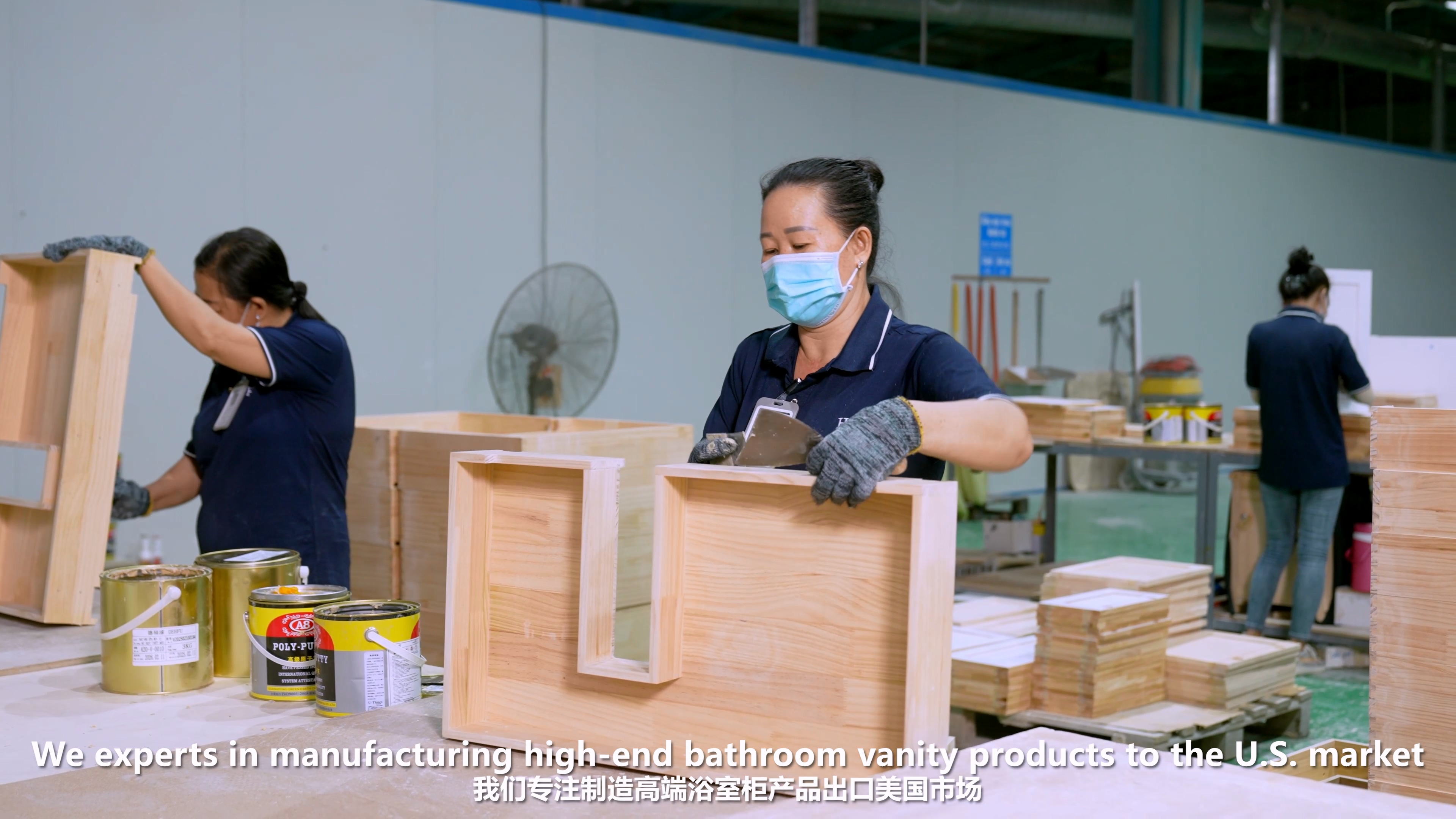
Drawer assembly for floating bathroom vanity cabinets; drawer count is the main storage variable between AS813048A and AS813050.
Freestanding: AS813049, 450×450×890 mm, one door
AS813049 is a freestanding bathroom vanity measuring 450×450×890 mm with a single door. The 450 mm width and depth make it viable where a hung cabinet is impractical — narrow bathrooms, awkward corners, or walls that cannot accept a hung load — and because it stands on the floor it needs no wall blocking. The single-door cabinet provides full-height internal storage rather than drawer segmentation. Freestanding bathroom furniture can also be repositioned during refurbishment, which matters in buildings where the bathroom layout is likely to be revisited.
Materials and finishes: plywood, solid wood, lacquer and melamine
SHKL vanities are available in plywood and solid wood construction, with lacquered and melamine finishes. Both wood constructions fall inside the wood-material segment that held a 34.9% revenue share of the market in 2025 (Grand View Research). Lacquered finishes deliver a uniform colour and sheen across a hotel floor, which is usually the deciding factor when cabinets from different production batches sit in adjacent rooms; melamine finishes extend the colour and pattern range where the design brief calls for a wider palette. Material and hardware selection should avoid inferior raw materials and low-end hardware components, because both affect moisture performance and long-term maintenance.
Production capability supports the finish decision. Panel processing at SHKL runs on more than 10 electronic saws, two CNC machining centers, laser edge sealing machines and six-sided drills, with quality inspection points across the full process. The Vietnam base includes a PU dust-free spray paint workshop for surface treatment.
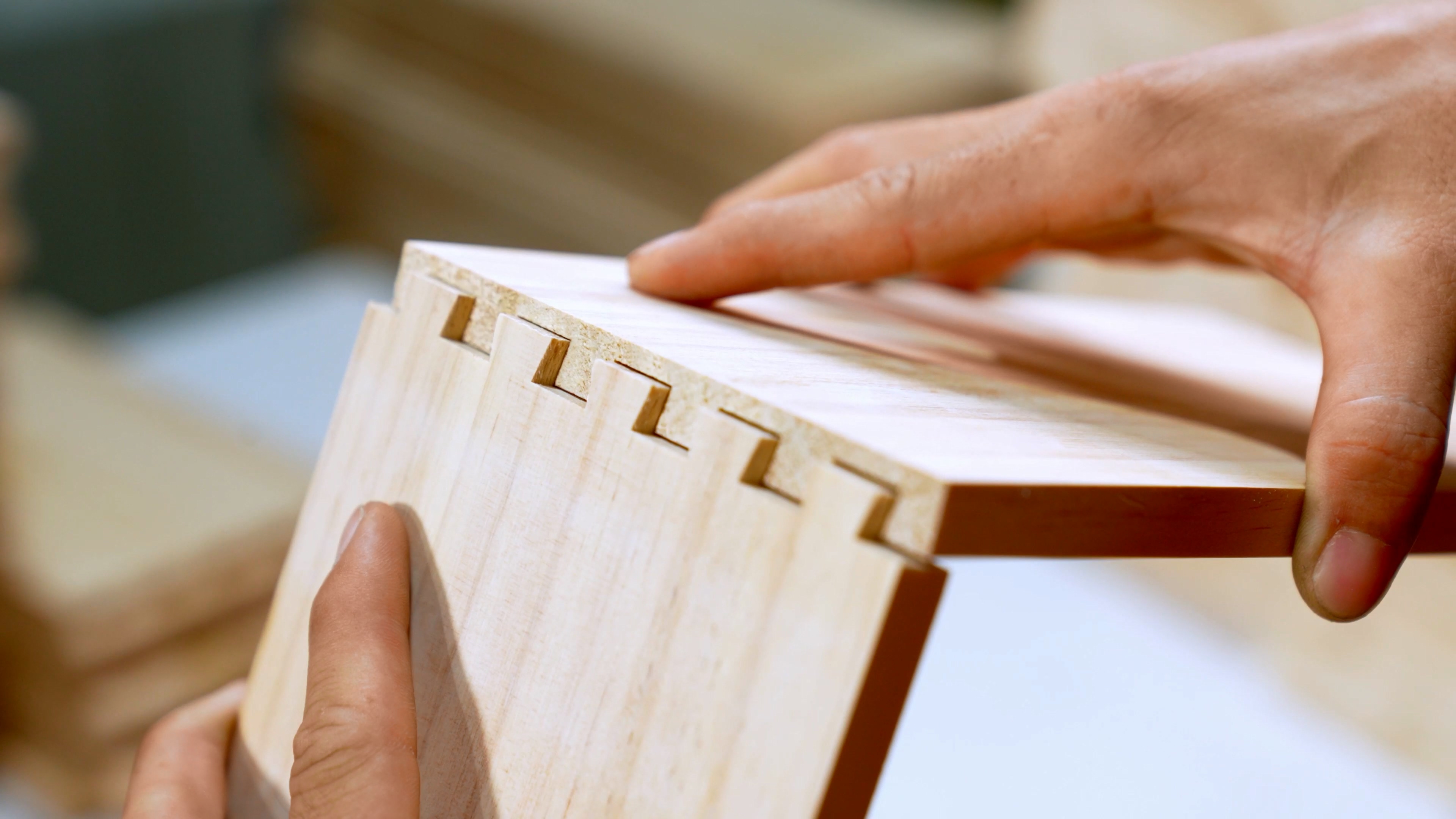
Mortise and tenon joint structure used in solid wood bathroom vanity cabinet construction.
LED mirror options that belong in the same specification
Mirrors are often specified separately from the cabinet, but in hospitality projects they share the same electrical rough-in. SHKL LED bathroom mirrors can be specified with defog, dimmable and three color temperature settings. Defog matters where a mirror is used immediately after showering; dimmable output and three colour temperature settings matter in guest rooms where the same fitting has to serve a morning shaving light and a low-level night light. Because the mirror and the wall-hung cabinet both fix to the same wall zone, the electrical points and the cabinet blocking should be coordinated in one drawing.
Step-by-Step Breakdown: Locking the Specification
- Measure the bathroom envelope and the clear floor target. Record the available wall run and the floor area that must remain free. A wall-mounted or floating cabinet preserves floor area; a freestanding cabinet occupies it.
- Confirm the wall substrate and fixing. KL813003, AS813048A and AS813050 are all hung units, so the wall has to accept the fixing and the loaded cabinet. Where that cannot be confirmed, AS813049 freestanding is the lower-risk route.
- Set the rough-in to match the mount type. A hung cabinet changes how the waste and supply connections are routed compared with a floor-standing unit, so the plumbing drawing should be issued after the mount type is fixed, not before.
- Select width and storage configuration. KL813003 covers 750–1200 mm; AS813048A provides two drawers, AS813050 one drawer, and AS813049 one door with a 450×450×890 mm body. Count what the room actually stores before choosing drawer count.
- Choose construction and finish by exposure and cleaning regime. Plywood and solid wood are both offered; lacquered finishes support batch-to-batch colour consistency across a floor, while melamine finishes widen the palette.
- Specify the mirror and its electrical points. Decide defog, dimmable and three color temperature settings at the same time as the cabinet, so the wiring and the blocking are installed in one visit.
- Confirm commercial terms and the programme. MOQ is 20 units, delivery terms are FOB and payment terms are T/T, with acceptance criteria verified by a pre-shipment test. Typical production lead time is 30 to 45 days, and the stated monthly production capacity is 10,000 units.
Use Cases
Compact urban apartment or powder room
KL813003 at the 750 mm end of its width range gives a wall-mounted vanity that keeps the floor clear in a bathroom where every centimetre of circulation counts. The same model family can then be specified at a wider size in the main bathroom of the same development, keeping hardware and finish consistent.
Primary residential bathroom with drawer storage
AS813048A, the two-drawer floating model, separates daily toiletries from stored items without adding a tall cabinet. Floating installation keeps the floor visible and makes cleaning around the basin faster.
Business hotel guest room
AS813050, the single-drawer floating cabinet, matches guest rooms where storage volume is modest but the floating look is required, and it pairs with an LED mirror specified with defog, dimmable and three color temperature settings. Housekeeping benefits from the clear floor, because the cabinet does not create a floor-level cleaning gap.
Serviced apartment, suite or narrow bathroom
AS813049 freestanding at 450×450×890 mm fits where the wall cannot carry a hung unit or where the plan leaves only a narrow slot. Its single door provides full-height storage, and the unit does not depend on wall blocking for installation.
Phased rollout or mock-up room
A mixed schedule can combine hung cabinets in guest rooms with freestanding units in suites. With an MOQ of 20 units, a mock-up bathroom or a single floor can be ordered as a first release before the full programme is released.
Comparison Table: Wall-Mounted vs Floating vs Freestanding
The table below compares the four reference models on confirmed facts only. Dimensions are stated only where they are confirmed for the model.
| Mount type | Model | Confirmed configuration | Installation implication | Typical project fit |
|---|---|---|---|---|
| Wall-mounted | KL813003 | Space-saving wall-hung cabinet, widths 750–1200 mm | Cabinet fixed to the wall; no floor footprint; blocking required | Compact residential bathrooms, powder rooms, hotel guest bathrooms |
| Floating | AS813048A | Floating cabinet with two drawers | Wall-hung; drawer storage; wall fixing required | Primary residential bathrooms, hotel guest rooms |
| Floating | AS813050 | Floating cabinet with one drawer | Wall-hung; compact storage; wall fixing required | Secondary bathrooms, smaller guest rooms |
| Freestanding | AS813049 | Freestanding cabinet with one door, 450×450×890 mm | Floor-standing; no wall load; compact 450 mm footprint | Narrow bathrooms, corners, suites, refurbishment projects |
All four models are available in plywood or solid wood construction with lacquered or melamine finishes.
FAQ
Do wall-mounted and floating vanities have to meet specific safety standards in North America?
Yes. In North America, bathroom cabinets and vanities must comply with UL 962, which covers stability, mechanical strength and flammability (UL Solutions). The requirement applies to the cabinet as a product, but wall-hung models — KL813003, AS813048A and AS813050 in the SHKL range — additionally depend on the wall fixing and substrate at the project site, because the cabinet carries its load without floor support. Specifying a compliant cabinet does not compensate for a wall that cannot accept the fixing, so the fixing detail belongs in the same specification package as the model number.
Can one manufacturer supply wall-mounted, floating and freestanding vanities for the same project?
SHKL produces all three mount types within one product program, so a mixed schedule can be consolidated with a single supplier. The reference models are KL813003 (wall-mounted, widths 750–1200 mm), AS813048A (floating, two drawers), AS813050 (floating, one drawer) and AS813049 (freestanding, one door, 450×450×890 mm). Bodies are offered in plywood and solid wood construction with lacquered and melamine finishes, and LED bathroom mirrors can be specified with defog, dimmable and three color temperature settings. Consolidation reduces the number of finish, hardware and mirror-control variables a project team has to approve.
What are the minimum order quantity, delivery terms and payment terms?
For the SHKL vanity range, MOQ is 20 units, delivery terms are FOB, payment terms are T/T, and acceptance criteria are verified by a pre-shipment test. These terms matter at specification stage because they determine whether a mock-up room, a single hotel floor or a full residential handover can be ordered as a separate release.
How should a project team validate the specification before a full order?
Lock four variables first: mount type and width, cabinet construction and finish, drawer or door configuration, and mirror function. Acceptance is then verified through the pre-shipment test, which checks the delivered configuration against the approved specification before shipment. With an MOQ of 20 units, a mock-up bathroom or a single guest-room prototype can be ordered as a first release. To start that process, request a sample and specification review at info@shklbathroom.com, or download the SHKL product catalogue below.
What is the production lead time, and how does it affect the installation sequence?
The typical production lead time is 30 to 45 days, and the stated monthly production capacity is 10,000 units. Lead time excludes transport and site works, so the critical planning point is the reverse: because wall-mounted and floating models need blocking and rough-in before the wall is closed, mount type, model and mirror electrical points should be confirmed at the start of the programme rather than when the cabinets arrive. Freestanding models such as AS813049 do not impose that wall dependency and can be scheduled later in the fit-out.
Conclusion
The mount-type decision can be reduced to three rules. Use a wall-mounted cabinet such as KL813003 where floor clearance and a flexible 750–1200 mm width range matter most. Use a floating cabinet — AS813048A for two-drawer storage, AS813050 for a single drawer — where wall-hung installation is confirmed and drawer organisation suits the room. Use a freestanding unit such as AS813049 at 450×450×890 mm where the wall cannot take a hung load, the plan is narrow, or the cabinet may need to move during refurbishment.
Whichever route a project takes, the sequencing is the same: confirm mount type, width, construction and finish, drawer or door configuration, and mirror function before the wall is closed. SHKL’s production capability — a 100,000 m² base in China, a 40,000 m² base in Vietnam, a 20-person R&D team and quality inspection points across the full process — supports that coordination, and vanities are covered by 5-year warranty support with one-stop after-sales service. Typical production lead time is 30 to 45 days, with an MOQ of 20 units on FOB terms.
Next Step
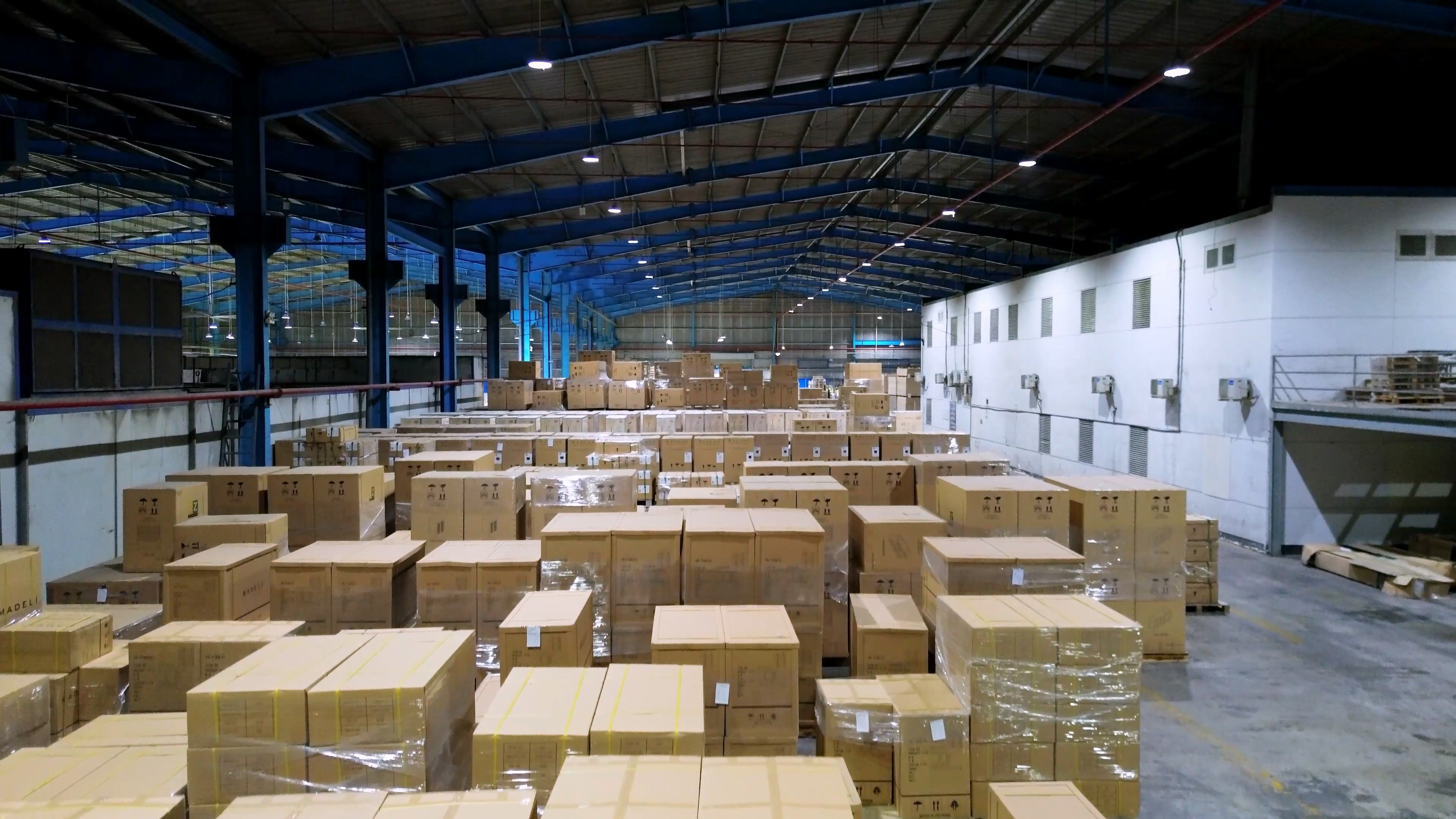
Finished bathroom vanity display at the SHKL production base; sample and specification requests are handled by the SHKL sales team.
Request a sample, a quotation or the full catalogue
Catalogue (PDF): SHKL product catalogue
Website: www.shklbathroom.com
Contact: Rita Luo · info@shklbathroom.com · ecommerce@shkl.cc
WhatsApp: +86 13790005061
Have Questions or Need More Details?
Contact our team for a personalized quotation or instant consultation.
Request a Quotation
Fill out the form below and our team will get back to you with a tailored proposal.
WhatsApp Direct Chat
Prefer to chat in real-time? Message us on WhatsApp for instant assistance & quick answers.
- Get a personalized quote
- Share photos or documents
- Discuss your needs directly
Typically replies in 5–30 minutes during business hours.