
Ceramic Basin vs. Sintered Stone Basin: A Head-to-Head Vanity Decision
The
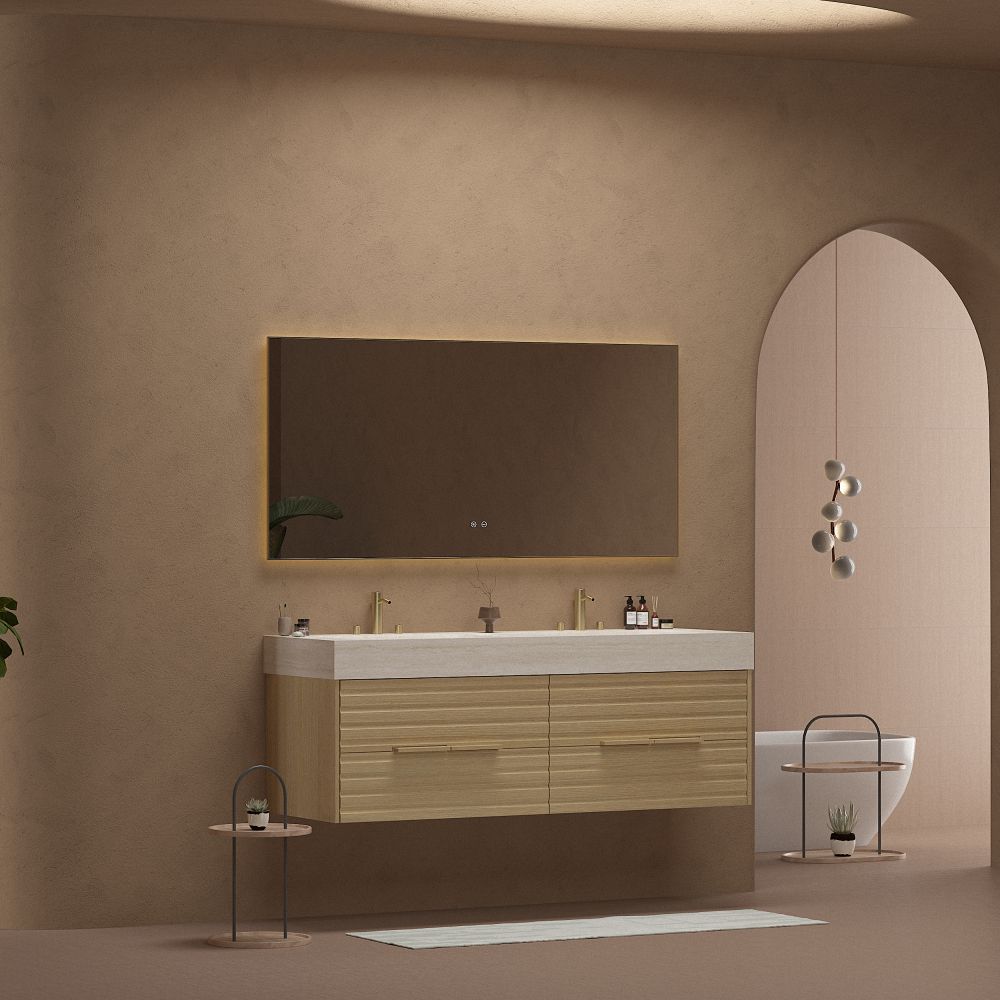
Short answer: a ceramic basin and an integral sintered stone basin solve different problems. A ceramic basin is a separate, replaceable component set into or onto a finished countertop. An integral sintered stone basin is formed as one continuous surface with the top. The correct choice is therefore not decided by which material sounds more advanced, but by where the joint will sit, how the unit will be cleaned, and who owns replacement when something fails in year four of a hotel programme.
This head-to-head comparison uses two documented models from the SHKL range as reference points: KL813003, a wall mounted bathroom vanity with an undermount ceramic basin and a Pure White Porcelain slab countertop, and AS813047, a two-drawer vanity with a sintered stone integral basin. SHKL (Foshan SHKL Sanitary Ware Co., Ltd) is a bathroom vanity manufacturer established in 2004 in Foshan, China, producing bathroom vanities, shower doors and LED bathroom mirrors, with production bases in China (100,000 m²) and Vietnam (40,000 m²), and exports covering Europe, Australia, North America, South America and the Middle East.
Everything below is drawn from the manufacturer's product, application and capability documentation. Where that documentation is silent — for example on impact resistance or installed price — the article states it is silent and indicates what a buyer should request in writing, rather than filling the gap with an assumption.
Problem definition: the joint line and the replacement unit
A bathroom vanity is a moisture-exposed piece of furniture with a working surface. Within that assembly, basin choice controls two things that determine long-term satisfaction far more than door style does.
The first is the interface between basin and countertop. Where two components meet, there is a perimeter, a seal, and a line that housekeeping has to work around. The second is the unit of replacement. When a surface chips, when a bowl is stained or damaged during a refurbishment, or when a spare is needed for a standardised room type, the question becomes whether the buyer replaces a basin, a countertop, or the whole top-and-basin assembly.
In a single household bathroom, either configuration can be maintained indefinitely with normal care. In a multi-room programme the calculation changes. SHKL's documented United States hotel bathroom project ran 250 units over a two-year period, with on-time delivery and product quality meeting US market standards. At that scale, a joint line becomes a housekeeping routine repeated across hundreds of rooms, and a basin becomes a stocked spare part rather than a one-off purchase.
That reframes the comparison. Durability, aesthetics and ease of cleaning remain the three evaluation criteria buyers ask about, but each one has to be answered at the level of the assembly — carcass, finish, hardware, countertop and basin together — not at the level of the basin material alone.
Industry background: the basin debate sits inside a wood-cabinet market
Third-party research places the global bathroom vanities market at roughly USD 43.34 billion to USD 47.22 billion in 2024/2025, with projections reaching up to USD 89.96 billion by 2034 (Fortune Business Insights and Grand View Research). Those absolute figures should be treated as directional: published estimates differ widely between research firms, with some valuing the same market far lower, so the useful signal is scale and continued growth rather than any single number.
Two structural facts matter more for this decision. First, the wood material segment — solid wood and plywood — held a 34.9% revenue share in 2025 (Grand View Research), which is consistent with both reference models here being built on plywood and solid wood carcasses. The basin argument therefore takes place inside a wood furniture decision, not instead of one. Second, residential applications accounted for approximately 74.9% of revenue share in 2025, meaning hospitality and contract work represent the smaller share of volume but the more demanding documentation requirement.
Form factor trends run alongside material choice. Wall-mounted and floating vanities are identified as a leading design direction for 2025–2026, while freestanding units still hold a significant share in North America at roughly 30% (Houzz / Homes & Gardens). For North American projects, bathroom cabinets and vanities are also subject to UL 962, the furniture safety standard covering stability, mechanical strength and flammability, as described by UL Solutions.
What this means for a specification: a large, fragmented market produces quotes that look alike on a drawing and differ substantially in the parts list. In most side-by-side comparisons, the differentiators are the basin joint, the slide and hinge brands, the finish system, and whether compliance documentation exists per model — not the shape of the door front.
Detailed solution: how the two configurations are actually built
The ceramic-basin configuration: a separate bowl in a finished slab
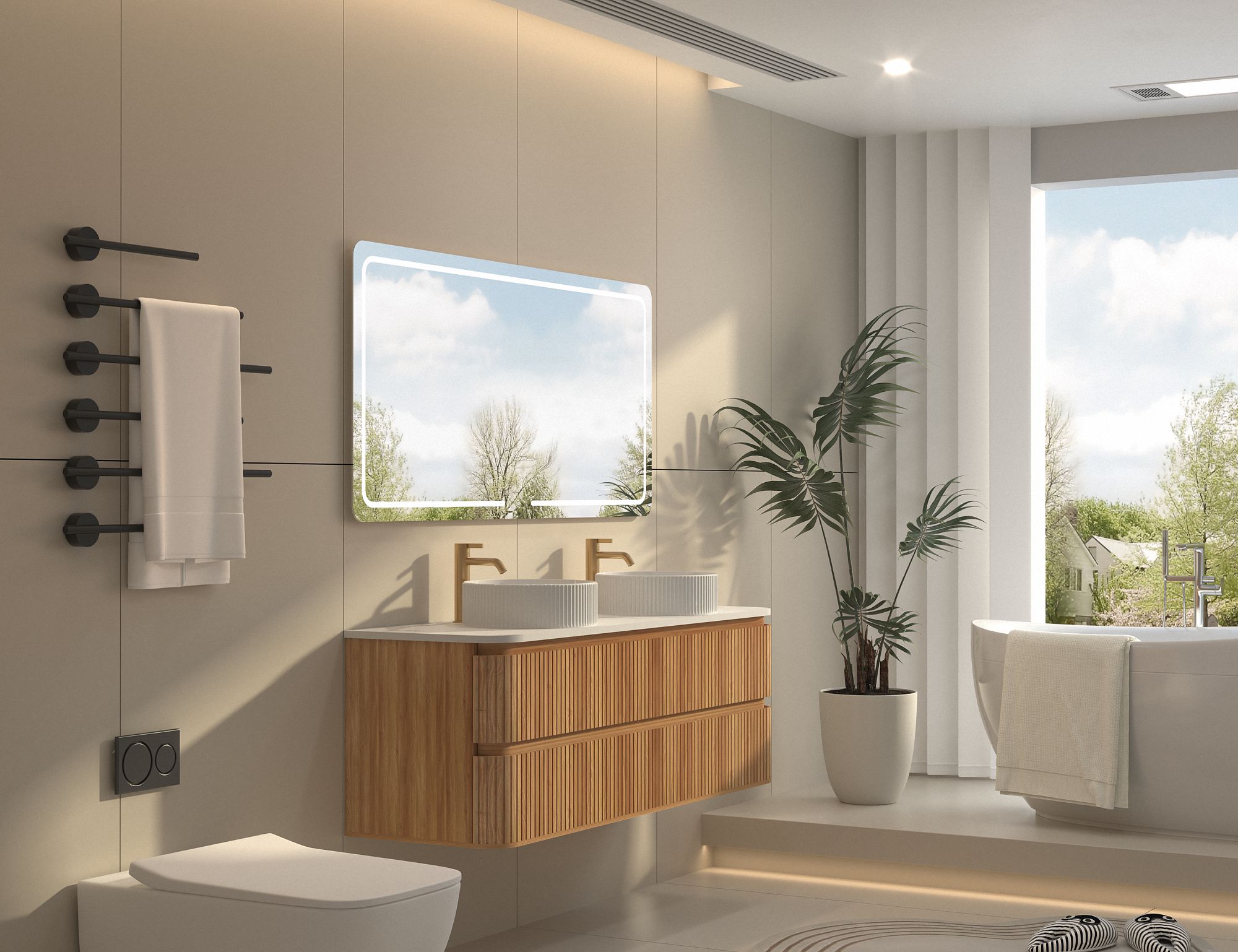
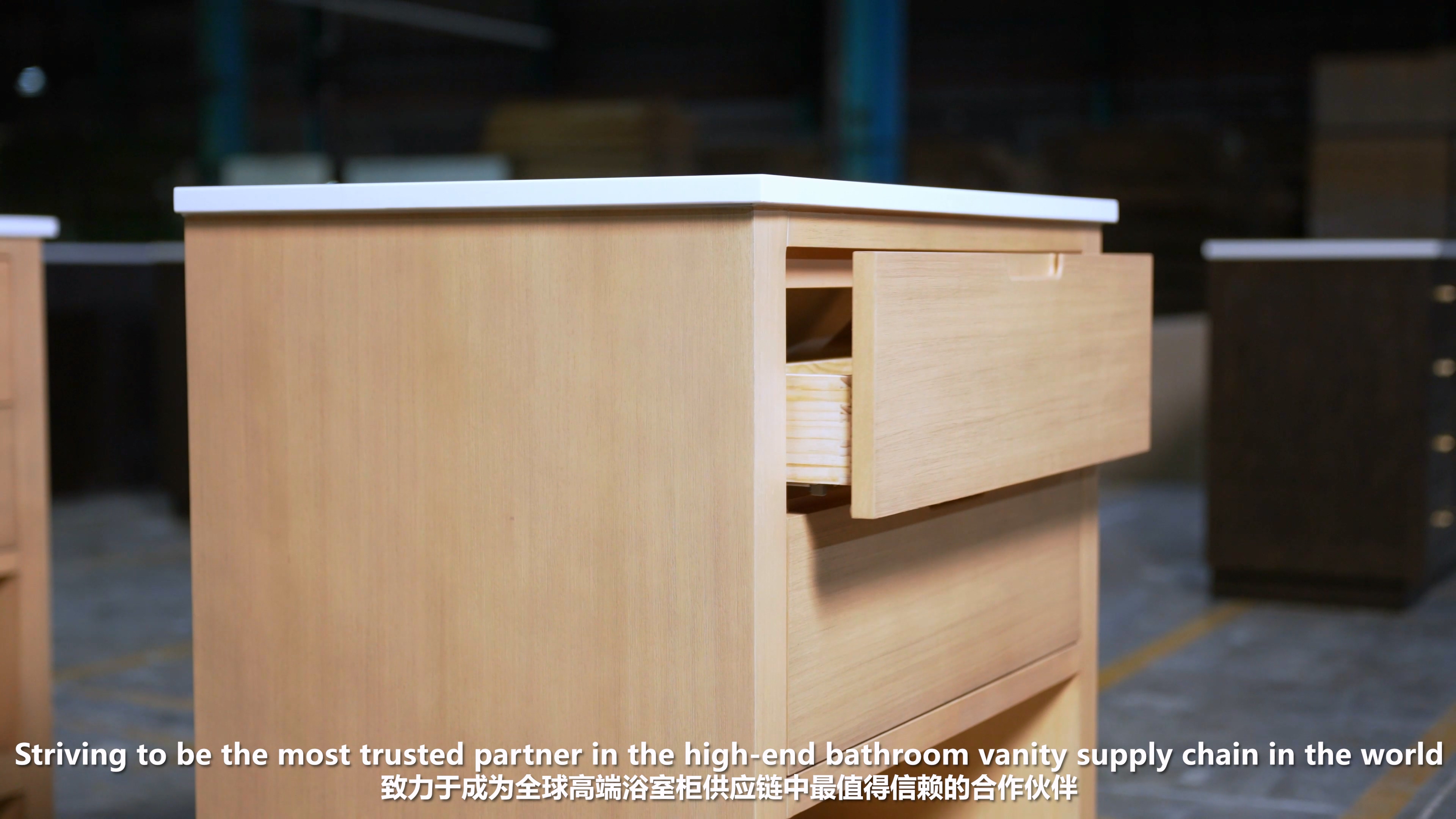
KL813003 is documented as a wall mounted bathroom vanity built from plywood and solid wood, finished in A2391 Acacia melamine with lacquered solid wood, and fitted with two drawers on DTC soft closing slides with a hidden handle to open. The countertop is a Pure White Porcelain slab; the basin is an undermount ceramic basin; the LED mirror supports different functions. Documented sizes are 750 / 800 / 900 / 1000 / 1200 × 520 × 504 mm.
The practical consequence of an undermount bowl is that the ceramic rim sits below the slab surface. Water and debris can be wiped from the countertop directly into the basin, and the visible edge is the cut edge of the porcelain slab rather than a ceramic lip. The trade-off is structural: the countertop and the basin are two components, joined by a sealed perimeter at installation. Either can be replaced without discarding the other.
The ceramic route is not limited to undermount. KL813001 uses an above-counter ceramic basin on a Pure White Porcelain slab, with one drawer on Unihopper push open slides and two doors on DTC hinges with a Hettich push open system — a vessel-style presentation in which the ceramic rim is deliberately visible. Glossy white ceramic basins also appear in floating configurations such as AS813050 (one drawer, Unihopper soft closing slides, Ancora Walnut lacquered and melamine finish) and AS813048A (a floating bathroom vanity with two drawers on Unihopper metal box soft closing slides).
The sintered stone configuration: one continuous surface
AS813047 is documented with a plywood and solid wood carcass, a Warm Mist Brown lacquered and melamine finish, two drawers on Unihopper soft closing slides, and a sintered stone integral basin. Its LED mirror is specified with a light gold aluminium frame, 5 mm copper-free glass, three colour temperatures, defog and dimming, controlled by two touch switch buttons.
"Integral" is the operative word. The basin is not a separate part in the delivered assembly; the surface and the bowl share one material and one continuous plane. There is no perimeter joint at the basin to seal, clean around, or re-seal later. The corresponding trade-off is that the top and basin age as a single component, so a chip or a stain is a decision about the whole surface rather than about one bowl.
The same logic scales down. AS813049 is a freestanding bathroom vanity with a 450 × 450 × 890 mm cabinet and a 500 × 1500 × 35 mm LED mirror, finished in Ancora Walnut lacquered and melamine, with one door on a DTC hinge and Hettich push open system, a sintered stone internal basin, and a light gold metal frame mirror with motion sensor switch, one colour temperature, backlight, defog and dimming.
Durability: what is documented, and what has to be requested
Neither specification states impact resistance, stain resistance, thermal shock performance, or glaze abrasion values. That is not a gap unique to these two models — most vanity specification sheets describe construction and finish, not material test data. A buyer comparing "durability" should therefore request written test data for the specific basin and surface rather than rely on the reputation of a material category.
What the documentation does allow is an evaluation of the parts that fail first in a wet room: the slides and hinges (DTC soft closing slides, Unihopper soft closing slides, Hettich push open systems and DTC hinges appear by name across the range), the carcass material (plywood and solid wood in both reference models), and the finish system (melamine panels combined with lacquered solid wood elements). Hardware brand and edge sealing are checkable facts; "premium stone" is not.
SHKL's application documentation records the special requirements that bathroom cabinet projects typically carry: moisture-proof, mildew-resistant and scratch-resistant performance, under long-term static installation with manual use. Those requirements apply to the whole assembly. A scratch-resistant requirement, for instance, is a question about the countertop and finish, while a mildew-resistant requirement is largely a question about joints, sealing and ventilation. Mapping each requirement to a specific component before ordering is more useful than debating basin material in the abstract.
Aesthetics: the rim reveal versus the continuous plane
Visually, the three options read very differently. An undermount ceramic basin (KL813003) makes the countertop the dominant plane and hides the ceramic entirely below it. An above-counter ceramic basin (KL813001) makes the bowl the object, with a visible glazed rim. An integral sintered stone basin (AS813047) removes the transition altogether: surface and bowl are one material, one colour and one plane.
The basin should also be read together with the cabinet language around it. KL813003 pairs its undermount bowl with A2391 Acacia melamine, lacquered solid wood and a hidden handle — a restrained, handle-free front. AS813047 pairs its integral surface with Warm Mist Brown lacquer and melamine and a light gold mirror frame. Neither pairing is objectively better; they signal different interior directions, and a project's design intent usually resolves the basin question before the technical comparison begins.
Cleaning and maintenance: fewer joints versus replaceable modules
An integral basin removes the perimeter joint entirely, so routine cleaning is a continuous wipe across one surface and one bowl. An undermount ceramic basin concentrates cleaning on one sealed line where the bowl meets the slab, plus the bowl itself. An above-counter bowl adds the outer wall and base of the vessel to the cleaning routine.
Maintenance philosophy is the sharper distinction. The ceramic route keeps the basin and the countertop as separate service items: a damaged bowl can be replaced without touching the porcelain slab, and a damaged slab can be replaced without sourcing a matching bowl. The integral route makes surface and basin one service item, which simplifies the bill of materials but makes any single defect a larger replacement. For a hotel keeping spares against a standard room type, that is a stocking decision as much as a design one.
Step-by-step breakdown: how to run the decision in six passes
Step 1 — Classify the project by usage intensity and cleaning regime. Residential daily use and hotel daily use are not the same duty cycle. SHKL application data describes both settings as long-term static installation with manual operation, but the number of users per basin and the cleaning products used differ, and that difference should drive the specification before aesthetics are discussed.
Step 2 — Decide the replacement model first. Component-level replacement points to a ceramic basin (KL813003) or a ceramic bowl on a porcelain slab (KL813001). Assembly-level replacement points to an integral sintered stone basin (AS813047, AS813049). This is usually a facilities or ownership decision rather than a designer decision, and it is the single question that most often reverses the material preference.
Step 3 — Match basin to countertop and mounting type, then freeze the pairing. KL813003 is a wall mounted bathroom vanity with an undermount ceramic basin in a Pure White Porcelain slab, in 750 to 1200 mm widths. AS813047 is specified with an integral sintered stone basin, and AS813049 is a freestanding unit with a sintered stone internal basin. Do not mix specifications from different assemblies in one purchase order — the basin, top and cabinet form one documented configuration.
Step 4 — Verify hardware and finish by name, not by adjective. Check that the quoted slides and hinges match the documented parts: DTC soft closing slides and hinges, Unihopper soft closing and metal box slides, Hettich push open systems. Ask which finish code applies (A2391 Acacia, A2392 Walnut, Ancora Walnut, Warm Mist Brown) and confirm the lacquer system on solid wood elements, since the finish is what the user actually touches every day.
Step 5 — Collect compliance documentation per model. For North American projects, UL 962 covers stability, mechanical strength and flammability of bathroom cabinets and vanities as described by UL Solutions. Confirm which standard applies in the destination market and request test documentation for the exact model quoted — not for the catalogue as a whole. The available model specifications for KL813003 and AS813047 describe construction and components, not certification status, so certification must be verified project by project.
Step 6 — Lock the supply parameters. SHKL's documented OEM capability covers a minimum order quantity of 50, a lead time of 30–45 days, 100% inspection, customization of size, colour, material, finish, hardware, logo and design style, plus warranty support, remote after-sales consultation and spare parts supply. Confirm packaging and handling for the unit size you have chosen, particularly where the basin and top form one larger component.
Use cases: matching the basin type to the project
Hotel renovation and hospitality programmes
KL813003 is documented as suitable for hotel projects. In that scenario its role is storage organization and bathroom space optimization, and it relies on supporting equipment including a ceramic basin, LED mirror, shower enclosure and faucet. That supporting-equipment list matters: in a hotel room the basin specification only performs as intended when the mirror, shower enclosure and tapware are coordinated with it.
SHKL's United States hotel bathroom project covered 250 bathroom furniture units over a two-year duration, with on-time delivery, product quality meeting US market standards and high customer satisfaction. The recorded highlights were design, product fidelity and compliance with customer requirements. For a programme of that shape, a ceramic basin that can be stocked and replaced at component level is the lower-risk specification.
Villa and residential projects

KL813003 is also documented as suitable for Villa Case projects and applied in that project type. SHKL's Australian villa OEM programme covered 100 bathroom furniture units with a stated 5–10 year service horizon, meeting villa design specifications with on-time delivery; the recorded highlights were practical, durable, well-designed products with a harmonious overall style.
In low-count, high-design residential work the balance shifts. A designer specifying a continuous stone surface will accept assembly-level replacement in exchange for the unbroken plane that AS813047 provides. The decision then rests on design intent rather than maintenance logistics, provided the buyer has confirmed the mounting type and dimensions directly with the manufacturer.
Compact and freestanding footprints
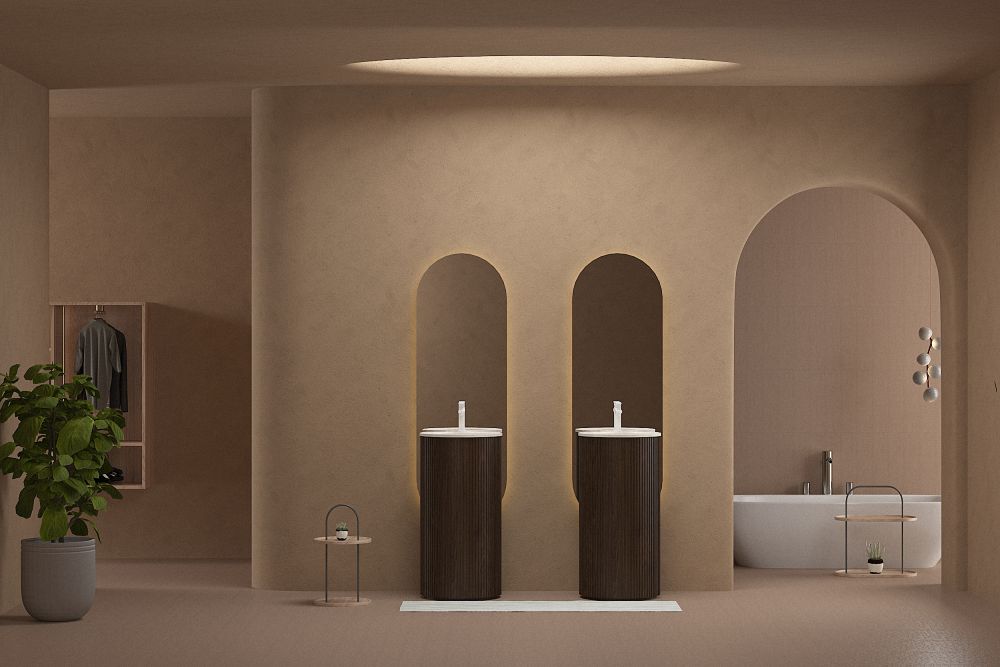
Where floor area is tight and wall fixing is impractical, a freestanding bathroom cabinet avoids wall-fixing requirements. AS813049 keeps the sintered stone basin option in that format at a 450 × 450 mm footprint. On the wall-mounted side, floating bathroom vanity formats remain the dominant design direction for 2025–2026, while freestanding units still account for a significant share in North America at roughly 30% — so both forms realistically appear in the same tender.
High-touch residential bathrooms
For buyers who want a bright, familiar bowl and a lower-friction service model, glossy white ceramic basins on a porcelain slab — as in AS813050 and AS813048A — keep the visual language of a conventional bathroom while using the same plywood and solid wood carcass and named hardware as the rest of the range. These are also the configurations most often chosen when a single bathroom vanity has to match existing sanitaryware already on site.
Comparison table: ceramic basin vs integral sintered stone basin
| Decision factor | Ceramic basin — KL813003 | Sintered stone basin — AS813047 |
|---|---|---|
| Basin construction | Undermount ceramic basin | Sintered stone integral basin |
| Countertop | Pure White Porcelain slab | Not listed as a separate item; the basin is integral to the surface |
| Cabinet material | Plywood and solid wood | Plywood and solid wood |
| Finish | A2391 Acacia melamine and solid wood lacquered | Warm Mist Brown lacquered and melamine |
| Drawer structure | Two drawers, hidden handle to open | Two drawers |
| Hardware | DTC soft closing slides | Unihopper soft closing slides |
| Mounting type in documentation | Wall mounted bathroom vanity | Documented as “Bathroom vanity”; mounting type to be confirmed with the manufacturer |
| Documented sizes | 750 / 800 / 900 / 1000 / 1200 × 520 × 504 mm | Not stated in the available specification |
| Mirror specification | LED mirror supporting different functions | Light gold aluminium frame, 5 mm copper-free glass, three colour temperatures, defog, dimmable, two touch switch buttons |
| Replacement unit | Basin and countertop are separate components | Surface and basin form one component |
| Documented project fit | Hotel projects (US); Villa Case projects (AU) | Not stated in the available project documentation |
| Cleaning focus | Sealed perimeter joint plus the bowl | Continuous surface and bowl, no perimeter joint |
All entries above are taken from the manufacturer's product and application documentation for the two named models. Where a field is not listed in that documentation, the table says so rather than inferring a value. OEM terms shown in this article — customization of size, colour, material, finish, hardware, logo and design style, MOQ 50, lead time 30–45 days, 100% inspection, warranty support, remote after-sales consultation and spare parts supply — apply to the SHKL manufacturing programme, not to a single catalogue model.
Frequently asked questions
1. Which safety standard applies to bathroom vanities specified for North American projects?
UL Solutions describes UL 962 as the furniture safety standard covering stability, mechanical strength and flammability for bathroom cabinets and vanities in North America. The basin choice does not change which standard category applies, but it does change the assembly being verified, so documentation should be requested for the exact model specified. The available specifications for KL813003 and AS813047 describe construction, finish, hardware and basin type; they do not state certification status. Confirm the requirement for the destination jurisdiction and request per-model test documentation before approving a purchase order.
2. Can one bathroom vanity manufacturer supply both ceramic-basin and sintered-stone-basin vanities in the same programme?
Yes. Both configurations exist within the SHKL range: KL813003 with an undermount ceramic basin, KL813001 with an above-counter ceramic basin, and AS813047 and AS813049 with sintered stone integral basins. SHKL's documented OEM capability covers customization of size, colour, material, finish, hardware, logo and design style, with 100% inspection, warranty support, remote after-sales consultation and spare parts supply. A mixed programme is therefore a specification exercise — fixing basin type per room category — rather than a sourcing problem, provided the MOQ of 50 and the 30–45 day lead time are planned into the schedule.
3. Which configuration is the better fit for a hotel renovation project?
For a hotel programme, the documented fit is KL813003, which is specified as suitable for hotel projects where its role is storage organization and bathroom space optimization, supported by a ceramic basin, LED mirror, shower enclosure and faucet. The operating logic behind that fit is component-level replacement: a ceramic basin can be exchanged without replacing the porcelain slab. SHKL's United States hotel bathroom project ran 250 units over two years with on-time delivery and product quality meeting US market standards. If a hotel specification instead prioritises a joint-free continuous surface, the sintered stone route should be confirmed directly with the manufacturer, since the available project documentation does not record a hotel reference for AS813047.
4. What drives the budget difference between the two configurations?
No price data is included in the available documentation, so the honest answer is a cost-structure answer rather than a number. The ceramic route involves two separate components — a Pure White Porcelain slab and a ceramic basin — plus the sealing step at installation, and it keeps basin and countertop as separate service items. The integral sintered stone route consolidates surface and basin into one component, which changes the bill of materials, the replacement unit and how spares are stocked. Size range, finish selection, hardware and mirror function are additional variables: KL813003 is available in five widths up to 1200 mm, while AS813047 carries a three-colour-temperature dimmable mirror. Request an itemised quotation per model so components can be compared line by line instead of as a single figure.
5. What MOQ and lead time should a project buyer expect?
SHKL's documented manufacturing terms are a minimum order quantity of 50 units and a lead time of 30–45 days, with 100% inspection and spare parts supply after delivery. Those figures apply to the manufacturing programme rather than to a single catalogue model, so they should be confirmed against the specific basin type, size and finish selected. Because a basin decision is difficult to reverse once a hotel floor is installed, the practical next step is to send the room schedule and finish references for a written quotation and specification confirmation — the current product brochure is available for download at SHKL bathroom products brochure.
Conclusion: a decision rule, not a material ranking
Choose the ceramic-basin configuration — KL813003 as the documented reference — when the project standardises room types, when basin-level replacement is required, when an undermount look with a hidden handle and a 750 to 1200 mm width range fits the plan, and when the programme carries a hotel reference requirement. It is also the configuration with documented hotel and villa project applicability.
Choose the integral sintered stone configuration — AS813047, or AS813049 where a freestanding 450 × 450 mm footprint is needed — when the design intent is a single continuous surface with no perimeter joint, and when the client accepts that surface and basin are one service item. Confirm mounting type, dimensions and handling arrangements with the manufacturer before the order is placed.
In both cases, three checks decide whether the specification survives contact with the building: named hardware rather than generic descriptions, written compliance documentation per model, and a fixed supply plan covering MOQ, lead time, inspection and spare parts. The basin material sets the look and the maintenance routine; those three checks set the risk.
Next step: request a project quotation
SHKL (Foshan SHKL Sanitary Ware Co., Ltd) supplies wood bathroom vanities, wall mounted and floating bathroom vanity formats and freestanding bathroom furniture for residential and hospitality projects, with OEM customization across size, colour, material, finish, hardware, logo and design style.
Contact: Rita Luo · Email: info@shklbathroom.com · WhatsApp: +86 13790005061 · Website: www.shklbathroom.com
Download the full catalogue before specifying: SHKL bathroom products brochure (PDF)
Have Questions or Need More Details?
Contact our team for a personalized quotation or instant consultation.
Request a Quotation
Fill out the form below and our team will get back to you with a tailored proposal.
WhatsApp Direct Chat
Prefer to chat in real-time? Message us on WhatsApp for instant assistance & quick answers.
- Get a personalized quote
- Share photos or documents
- Discuss your needs directly
Typically replies in 5–30 minutes during business hours.