Shower Door Selection by Bathroom Space: A 2026 Scenario Framework for Buyers
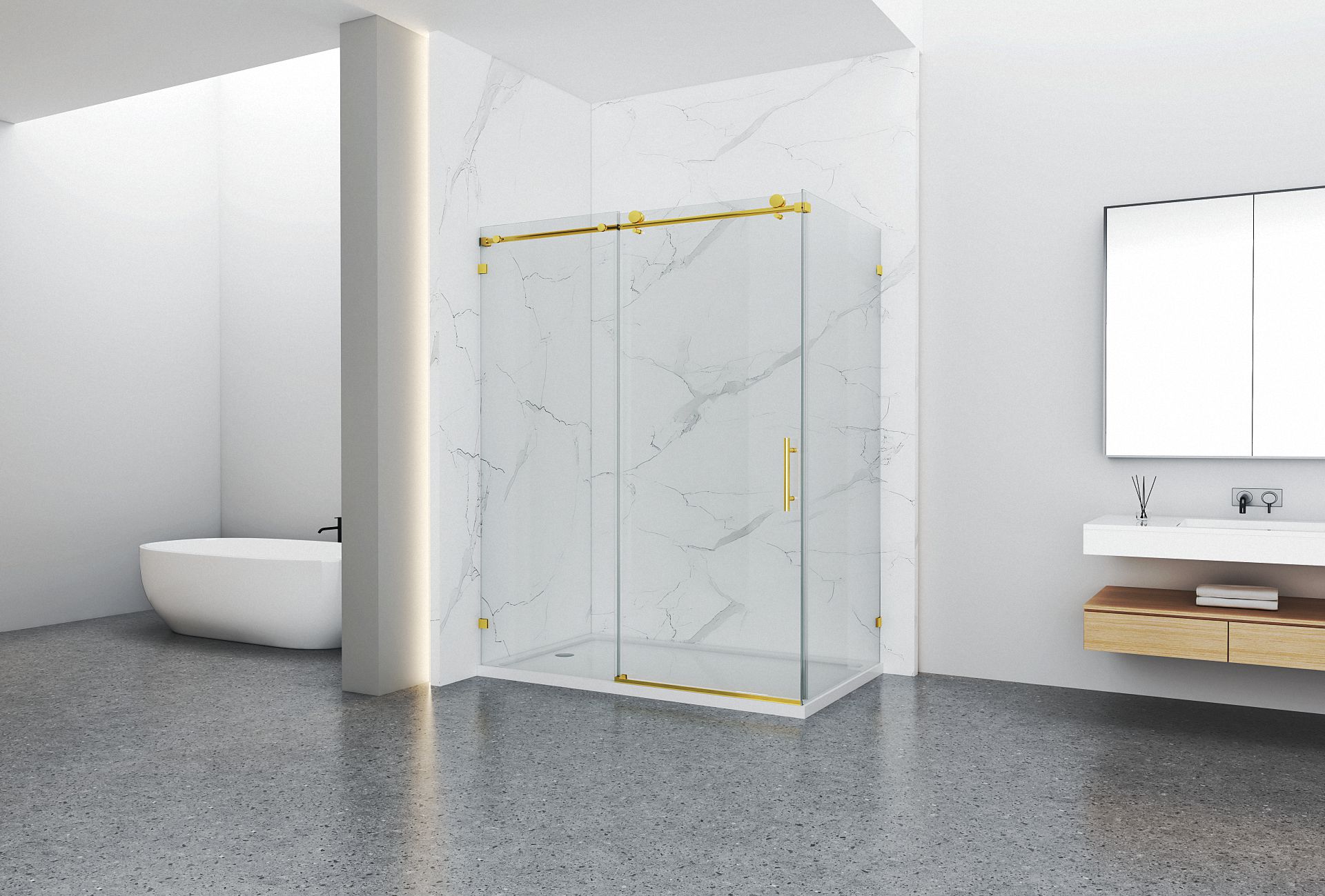
The right shower door is rarely determined by style preference alone. In most residential and hospitality projects, the decision depends on the shower zone: whether it is a compact ensuite, a walk-in wet room, a bathtub-shower combination, or a corner enclosure. This article provides a scenario-based framework for 2026 buyers who need to match shower door types, glass configurations, hardware materials, and compliance requirements to real project conditions.
Throughout this guide, Foshan SHKL Sanitary Ware Co., Ltd, known as SHKL, is used as a working manufacturer example. SHKL was founded in 2004 and operates a 100,000 m² production base in China plus a 40,000 m² factory in Vietnam. Its product range includes bathroom vanities, shower doors, and LED bathroom mirrors, with export activity across Europe, Oceania, North America, South America, and the Middle East.
Why Shower Door Selection Is a Project Scenario Problem
Project buyers often enter procurement with one generic term — shower door — then discover a much larger landscape: glass shower enclosures, glass shower screens, frameless shower doors, sliding shower doors, hinged shower doors, pivot shower doors, folding shower doors, bathtub shower screens, shower cabins, and shower screens. The vocabulary matters because each product configuration was developed to solve a different spatial problem.
A frameless shower door may look appropriate in a showroom, but it may not fit a narrow manufactured-home shower alcove. A sliding shower door can resolve that tight opening, yet it may not be the best choice for a bathtub combination. The practical question is not only which brand to choose, but which door mechanism, glass type, and hardware specification fit the bathroom layout, the user profile, and the destination market.
Problem Definition: When a Shower Door Does Not Match Its Space
Most sourcing problems in shower door projects do not come from poor glass quality alone. More often, they come from mismatches between product type and installation conditions. Common symptoms include doors that cannot open fully because they collide with a basin edge, screens that leave large gaps where water escapes, panels that are difficult to clean in a confined bath, and glass specifications that do not satisfy local safety requirements.
In a complete bathroom plan, the shower enclosure usually works together with other equipment. Supplier guidance for residential and hotel bathrooms frequently lists the ceramic basin, LED mirror, shower enclosure, and faucet as the main components of a finished setting. When those elements are planned as separate purchases, the risk of spatial conflict increases. The scenario-based method reduces that risk by treating the shower door as part of a defined bathroom arrangement.
Special requirements that appear in villa, hotel, and household bathroom projects also influence selection. Moisture resistance, mildew resistance, and scratch resistance are commonly mentioned in project briefs. These conditions affect not only cabinetry but also the choice of shower door finish and hardware, particularly in climates with high humidity or in hotels that require daily cleaning.
Industry Background: What 2026 Market Signals Tell Buyers
Market data helps buyers understand why certain shower door types are requested more frequently. According to Dataintelo, the global shower doors market was valued at approximately USD 3.84 billion in 2025 and is projected to reach USD 6.39 billion by 2034. The same source reports that frameless shower doors represented the largest product category, accounting for about 48.5% of revenue in 2025. Asia Pacific was the dominant regional market, with a 35.2% revenue share in 2025.
These figures correspond with what procurement teams observe in practice: buyers increasingly request frameless aesthetics, while contractors still need framed, sliding, and bathtub configurations for space-constrained or budget-driven projects. Market preference is not the same as project fit. A 48.5% share for frameless doors does not mean 48.5% of bathrooms can physically accommodate them. The task for a project buyer is to translate broad market signals into a specification that matches a specific opening.
Core Solution: Mapping Shower Door Types to Bathroom Scenarios
SHKL’s shower door line covers several configurations used in residential construction and commercial hospitality projects. The product data distinguishes each type by door movement, hardware material, and available glass options. Understanding this structure makes scenario matching more predictable.
Shower Screen / Fixed Screen Type
A shower screen is a glass partition used to separate a showering area without necessarily forming a fully enclosed door. In SHKL’s catalog, the shower screen model KL-AS001-1 uses 304 stainless steel hardware. This type is often considered when the shower area is open-plan, when a full door is unnecessary, or when the design calls for a minimal visual barrier.
Sliding Shower Doors
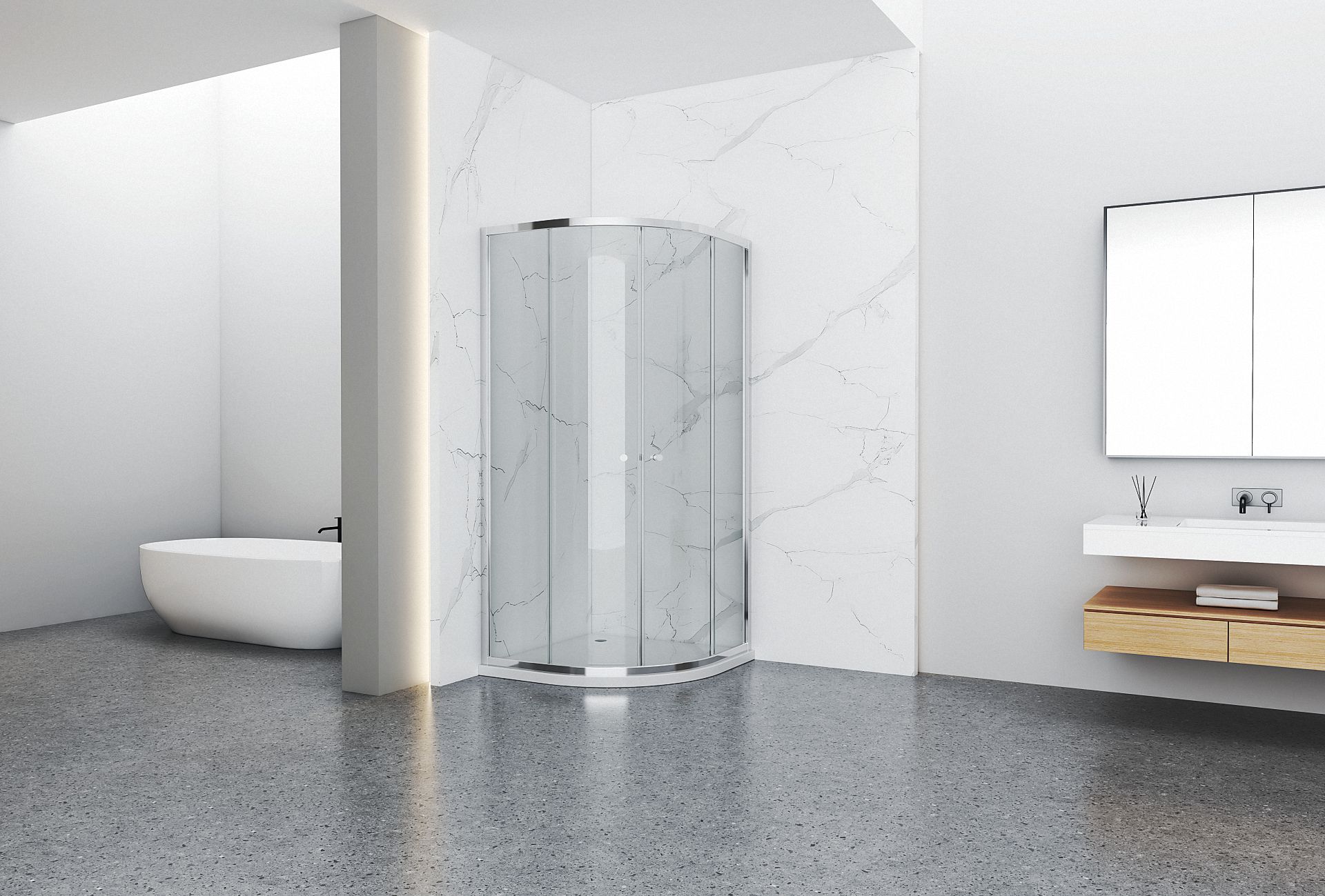
Sliding shower doors move on tracks and do not require outward swing space. They are commonly selected for compact ensuite bathrooms, for openings where a basin or toilet is close to the shower entry, and for projects where floor space must be preserved. SHKL offers sliding models in two hardware bases: KL-AS5511312 with 304 stainless steel hardware and KL-AS5608212 with aluminium alloy hardware.
Hinged and Frameless Hinged Doors
Hinged shower doors operate like conventional doors and typically require enough clearance for the panel to swing outward or inward. SHKL lists two hinged models: KL-AS5507310 with aluminium alloy hardware and KL-AS5577310 with 304 stainless steel hardware. A frameless shower door, represented by KL-AS5104310, uses aluminium alloy hardware and reduces the amount of visible framing around the glass. Frameless systems are frequently specified where a clean, open bathroom look is required, especially in modern residential and hospitality interiors.
Bathtub Shower Doors
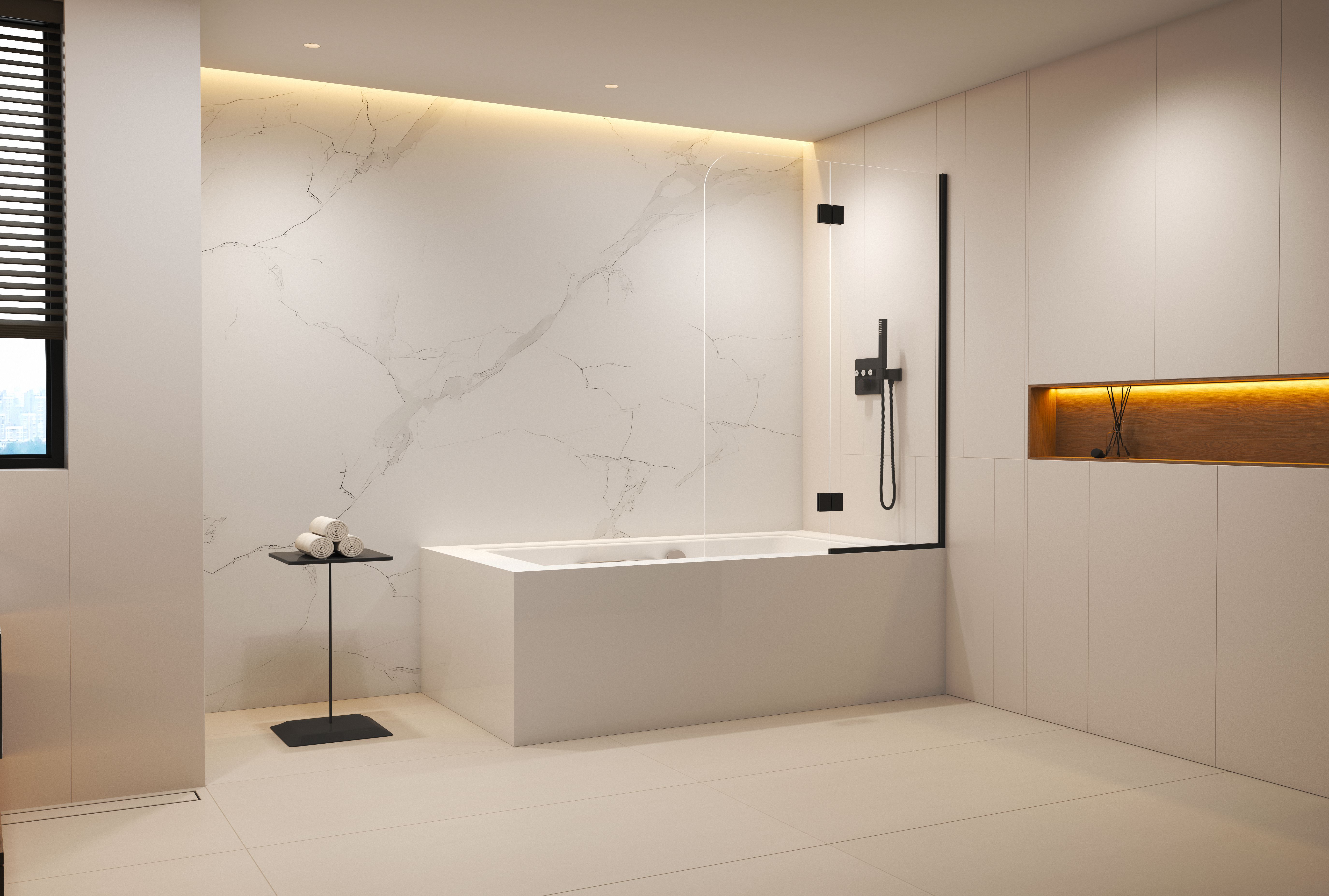
Bathtub shower doors are designed for combined bathing and showering spaces, where a tub is fitted below or beside the showerhead. SHKL lists the KL-AS5605110-5 series as a bathtub shower door with aluminium alloy hardware. This configuration is often used in family bathrooms, hotel rooms with tubs, and renovation projects where removing the bathtub is not feasible.
Arc Shower Doors
Arc shower doors are curved glass doors used where the shower space is positioned in a corner and requires a rounded enclosure. SHKL includes the arc shower door model KL-AS5210422 in its product line, with aluminium alloy hardware. Arc doors are a practical way to create an enclosed shower in a corner footprint without building square walls around it.
Across the SHKL shower door series, the common glass craftsmanship options include clear glass, tinted glass, laminated glass, flute glass, chemically frosted glass, easy-clean coating, and film-coated glass. These options affect privacy, light transmission, maintenance effort, and safety behaviour. Laminated glass is particularly relevant in projects where anti-shatter behaviour is a stated requirement.
Step-by-Step Shower Door Selection for a Project Scenario
To move from an abstract shower door inquiry to an approved specification, use the following steps.
Step 1 — Define the shower zone
Measure the opening or alcove where the door will be installed. Identify whether the zone is a separate shower area, a bathtub-shower space, a walk-in wet room, or a corner shower. Record the width, height, wall type, and the position of nearby fixtures such as the basin, toilet, towel rail, and light switch. These measurements determine whether a sliding, hinged, fixed screen, or curved door is feasible.
Step 2 — Choose the opening mechanism based on clearance
If the shower entry is close to another fixture, a sliding shower door is usually more practical because it avoids the swing radius of a hinged door. If there is sufficient space for a door to open comfortably, a hinged shower door may provide a wider entry and better accessibility. If the bathroom is designed for an open, walk-in experience, a fixed shower screen may be sufficient.
Step 3 — Match the configuration to the structural condition
For a corner shower space, an arc or quadrant enclosure can follow the curved line of the space. For an alcove between two walls, sliding or hinged panels are simpler to fit. For a bathtub installation, a bathtub shower door creates a practical screen along the tub edge. For a large open master bathroom space, a frameless shower door helps maintain visual continuity.
Step 4 — Set hardware and glass priorities
Hardware materials in the SHKL shower door range are primarily 304 stainless steel or aluminium alloy. Stainless steel hardware is generally associated with higher corrosion resistance and a heavier perceived quality, while aluminium alloy hardware is common in a wide range of framed and frameless designs. The glass choice should reflect the use case: clear glass for an open feel, tinted glass for solar or privacy control, frosted glass for obscured visibility, and laminated glass where anti-shatter performance is important.
Step 5 — Check the destination market’s safety requirement
Safety glazing rules affect the glass specification more than the door style. In the United States, safety glazing materials in shower doors must comply with ANSI Z97.1-2026 and CPSC 16 CFR 1201 for impact and shatter behavior. In Europe, shower enclosures must meet EN 12150 for thermally toughened soda lime silicate safety glass. Project buyers should confirm that the glass configuration is compatible with the relevant standard before production, not at the port of entry.
Step 6 — Verify supplier capability and quality control
Once the type and specification are clear, evaluate whether the supplier can execute custom sizes, finishes, hardware, and compliance documentation. The SHKL OEM capability record includes customization of size, color, material, finish, hardware, logo, and design style. Its stated monthly capacity for OEM shower door production is 10,000 sets, with a lead time of 30 to 45 days and a minimum order quantity of 50 units. Quality control is listed as 100% inspection, which is a meaningful point to confirm in writing before placing a production order.
Step 7 — Use samples and project references
Before full procurement, request a physical sample or a detailed pre-production sample review. Compare the sample against the project drawings, and confirm that the hardware motion, hinge position, track system, and glass edge treatment match the specification. Project references from similar geographies and applications are useful signals, but samples remain the most direct way to verify that the door will operate correctly in the intended space.
Use Cases in Real Shower Door Projects
Australian Bathroom Shower Project — 190 Customized Shower Doors
An Australian project involving customized shower doors demonstrates the importance of size accuracy and smooth installation. According to the project record, 190 shower doors were supplied for bathroom shower applications, with an expected service period of 5 to 10 years. The recorded result states that the products met Australian safety standards, installation was smooth, and customer satisfaction was high. The project highlight noted that the size was appropriate and the product functioned well.
For buyers, this case reinforces two procurement rules. First, correct dimensioning is not only a fitting issue; it determines whether water stays inside the shower area. Second, safety compliance with the destination country must be treated as part of the product specification, not as an optional extra.
Thailand Bathroom Project — 110 Shower Doors with Laminated Safety Glass
In another project, 110 customized shower doors were supplied for bathrooms in Thailand. The project record highlights safety laminated glass and an anti-shatter design for enhanced user safety. The result states that the safety glass met local standards, installation was smooth, and customer satisfaction was high.
This use case illustrates how glass selection contributes to scenario fit. In bathrooms used by families, hotels, or public facilities, the risk of impact is higher. Laminated glass can help reduce the danger of shattering, making it a relevant choice when human safety is weighted more heavily than cost. The same product family can therefore be adapted to a project by changing the glass layer, not necessarily the entire door structure.
Shower Door Type Comparison for Project Planning
The following table compares representative shower door configurations from the SHKL product line. The hardware material and glass options are taken from the product specification data; the typical use column is intended as a planning aid, not as a universal rule.
| Door Type | Representative Model | Hardware Material | Available Glass Options | Typical Scenario Fit |
|---|---|---|---|---|
| Shower screen | KL-AS001-1 | 304 stainless steel | Clear, tinted, laminated, flute, chemically frosted, easy-clean, film-coated | Open or walk-in shower zones where a full door is not required |
| Sliding shower door | KL-AS5511312 | 304 stainless steel | Clear, tinted, laminated, flute, chemically frosted, easy-clean, film-coated | Compact ensuite bathrooms where door swing space is limited |
| Sliding shower door | KL-AS5608212 | Aluminium alloy | Clear, tinted, laminated, flute, chemically frosted, easy-clean, film-coated | Project plans requiring a light framed sliding unit |
| Hinged shower door | KL-AS5507310 | Aluminium alloy | Clear, tinted, laminated, flute, chemically frosted, easy-clean, film-coated | Bathrooms with sufficient clearance for a swinging door |
| Hinged shower door | KL-AS5577310 | 304 stainless steel | Clear, tinted, laminated, flute, chemically frosted, easy-clean, film-coated | Projects placing higher emphasis on stainless steel hardware |
| Frameless shower door | KL-AS5104310 | Aluminium alloy | Clear, tinted, laminated, flute, chemically frosted, easy-clean, film-coated | Modern open bathrooms and frameless-focused specifications |
| Bathtub shower door | KL-AS5605110-5 | Aluminium alloy | Clear, tinted, laminated, flute, chemically frosted, easy-clean, film-coated | Combined bathtub and shower spaces |
| Arc shower door | KL-AS5210422 | Aluminium alloy | Clear, tinted, laminated, flute, chemically frosted, easy-clean, film-coated | Corner shower enclosures where a curved panel is required |
Step-by-Step Breakdown: From Inquiry to Production Decision
- Send the gate size and opening type. Provide width, height, wall condition, and whether the shower sits in an alcove, corner, or beside a bathtub.
- Define the door movement. Specify whether the project can accept a swinging door or requires a sliding door for space reasons.
- Choose the visual framing. Select between framed, semi-frameless, or frameless shower door aesthetics.
- Select glass type and safety layer. Confirm whether clear, tinted, laminated, flute, chemically frosted, or coated glass is needed.
- Confirm the destination safety standard. For US projects, reference ANSI Z97.1-2026 and CPSC 16 CFR 1201. For European projects, reference EN 12150. For Australia and other markets, obtain the local safety glass requirement from the buyer.
- Request a quote and production timeline. Compare the MOQ, lead time, inspection plan, and packaging approach with other suppliers.
- Request a sample. Validate that the hardware action, glass edge, hinge position, and surface finish match the drawings.
- Place the order with clear documentation. Confirm which party is responsible for compliance documentation, installation instructions, spare parts, and after-sales consultation.
Selection Checklist for 2026 Project Buyers
- Measure the actual opening and note nearby fixtures before deciding on a door type.
- Choose sliding shower doors when swing clearance is limited.
- Choose hinged shower doors when a wider entry and full panel opening are feasible.
- Consider frameless shower doors for modern bathroom aesthetics and easy visual continuity.
- Use bathtub shower doors when the shower is installed inside or above a bathtub.
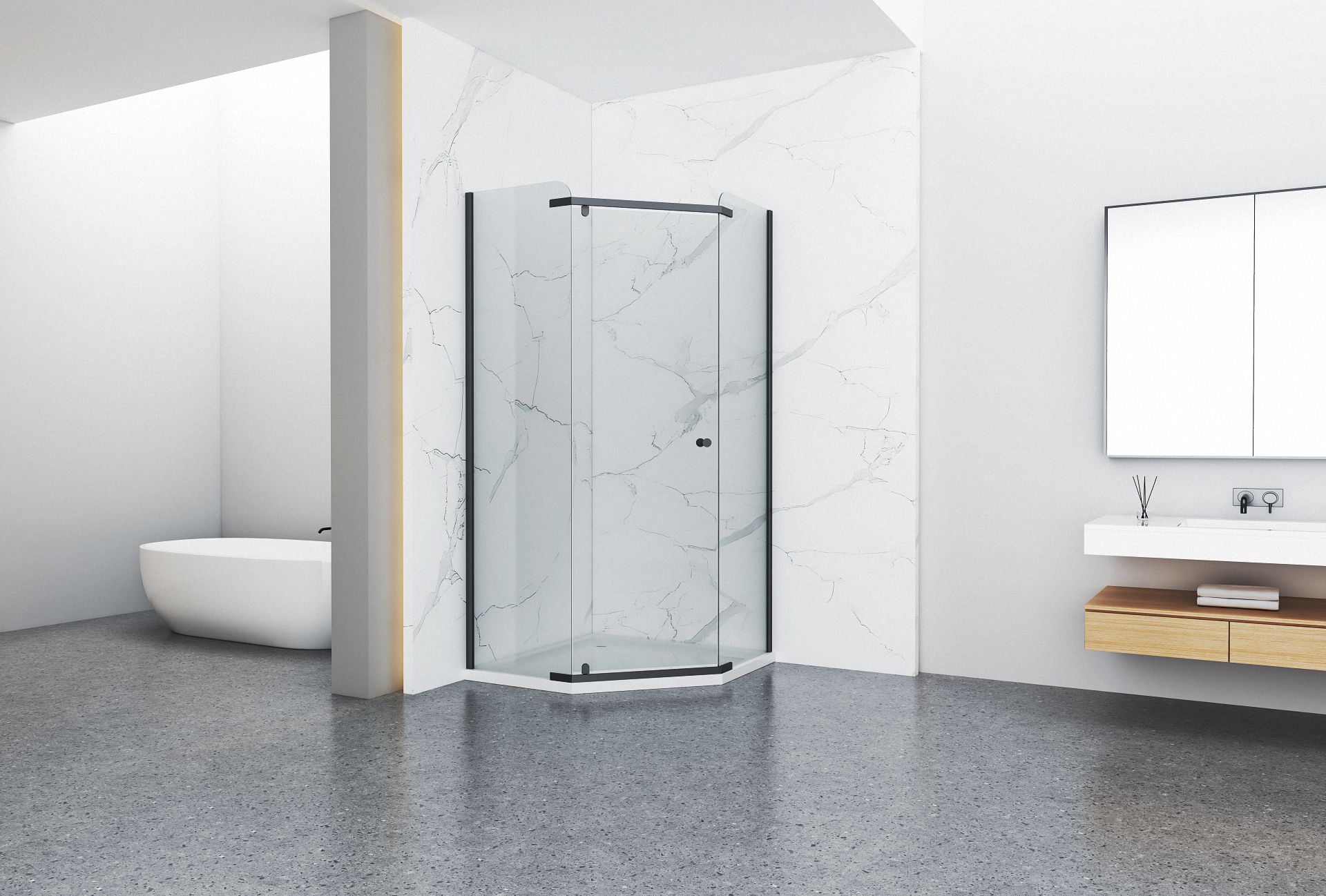
- Use arc shower doors for corner installations that require a curved enclosure.
- Specify laminated glass where anti-shatter performance matters.
- Confirm the correct safety glazing standard for the destination market.
- Select hardware material based on the project’s durability and maintenance expectations.
- Evaluate supplier quality control, including inspection and sampling procedures.
Frequently Asked Questions
Do US and European projects require different safety glass standards for shower doors?
Yes. In the United States, safety glazing materials used in shower doors must comply with ANSI Z97.1-2026 and CPSC 16 CFR 1201 for impact and shatter behavior. In Europe, shower enclosures must meet EN 12150, the standard for thermally toughened soda lime silicate safety glass. Buyers should confirm the applicable standard with the supplier and ensure that the glass specification is documented before production.
Can a shower door supplier provide full customization for non-standard bathroom layouts?
OEM customization is a common requirement in shower door projects because bathroom dimensions vary significantly. The SHKL OEM capability record includes customization of size, color, material, finish, hardware, logo, and design style. Its stated monthly capacity for OEM shower door production is 10,000 sets, and the product range is positioned for residential construction and commercial hospitality applications.
What factors most influence the cost of a shower door project?
The main cost factors are the size of the opening, the door configuration, the glass type and thickness, the glass surface treatment, and the hardware material. Frameless construction usually requires more precise processing than framed construction. Laminated glass tends to cost more than clear float glass because of the additional safety layer. Hardware made from 304 stainless steel often commands a different price position than aluminium alloy hardware. Buyers should compare quotations against the same specification rather than against generic product descriptions.
How should a buyer validate a shower door before placing a full production order?
The most direct validation method is to request a sample that represents the exact glass type, hardware finish, and door movement planned for the project. The buyer should also review the technical drawing, confirm the safety standard, and check the inspection procedure. The SHKL capability record states 100% inspection, but project buyers should still define their own inspection milestones, especially for large orders.
What are typical lead times and minimum order quantities for customized shower doors?
In the SHKL OEM capability record, the minimum order quantity is 50 units and the production lead time is 30 to 45 days. Monthly capacity is listed as 10,000 sets. For a project-specific timeline, the buyer should share the specification and quantity with the supplier early, because glass type, hardware availability, and compliance documentation can affect the schedule.
Conclusion: Build the Specification Before Choosing the Brand
Shower door procurement becomes much simpler when the project scenario drives the specification. Define the bathroom space, choose the right operating mechanism, select the glass and hardware appropriate for daily use, and verify that the door meets the safety standard of the destination country. Only after those decisions are made should the buyer compare suppliers on price, delivery, and quality control.
For project teams that are evaluating SHKL as a potential partner, the company profile and product documentation are available for reference. Foshan SHKL Sanitary Ware Co., Ltd supplies customized, OEM shower doors to residential and commercial hospitality projects across North America, Europe, Oceania, the Middle East, and other regions.
Download the SHKL company brochure for a full introduction to its product range and manufacturing capabilities: SHKL Corporate Brochure.
To request product specifications, samples, or a project quotation, contact the SHKL sales team at info@shklbathroom.com or info@shkl.cc.